
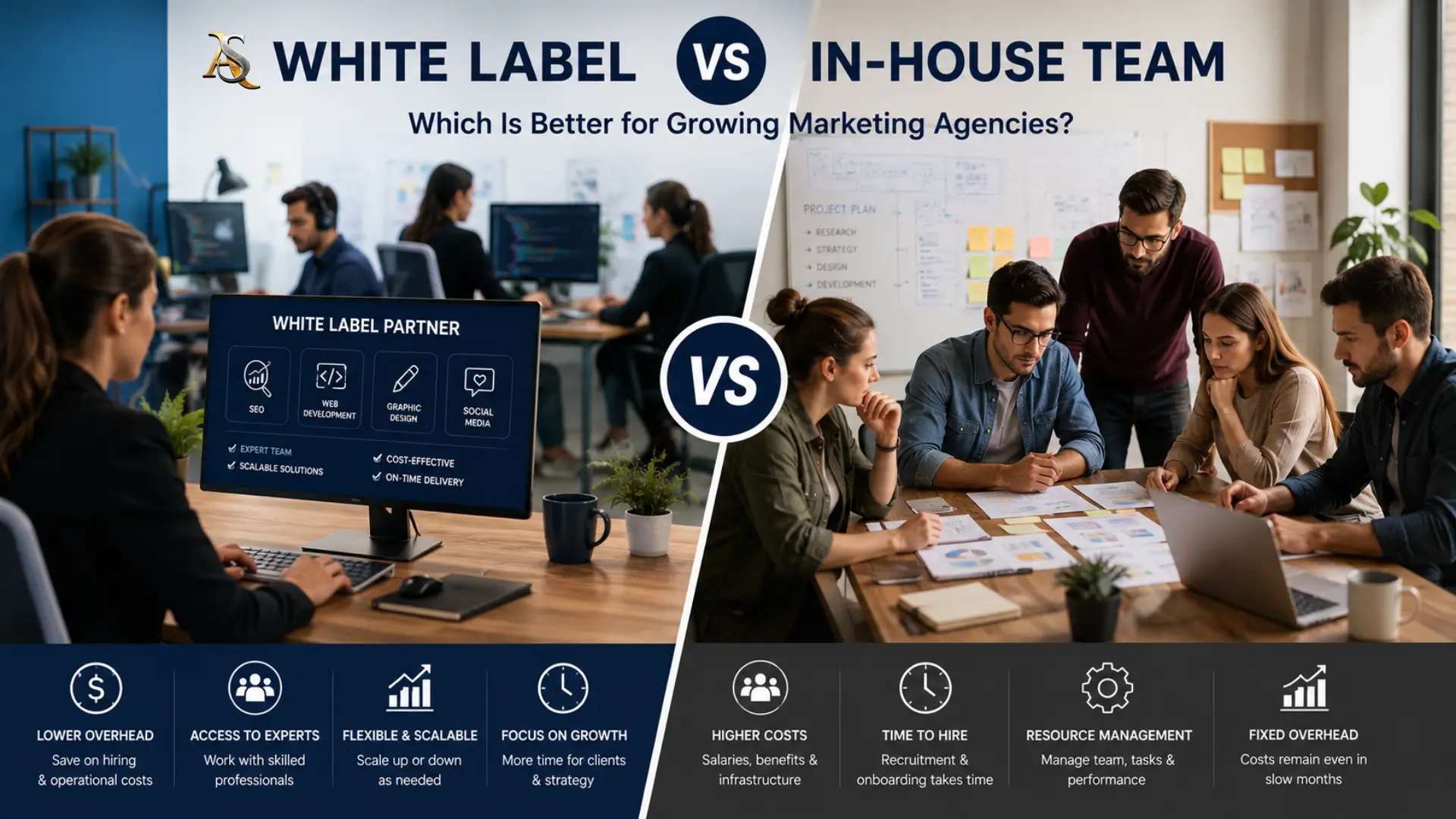
POST BY

aura solution
PUBLISHED
September 3, 2026
CATEGORY
Development
aura solution
Web Developer
Introduction
Every growing marketing agency eventually reaches the same critical point.
More clients begin coming in.
Existing clients request additional services.
Projects become larger and more complex.
And suddenly, the agency owner faces an important question:
Should we hire more people or partner with a White Label provider?
At first, building an in-house team may seem like the obvious next step.
You hire a designer.
Then an SEO specialist.
A social media manager.
A web developer.
Perhaps a video editor and paid advertising specialist.
Before long, your agency has a larger team—but also significantly higher monthly expenses, more management responsibilities, recruitment challenges, and pressure to keep everyone consistently busy.
The alternative is White Label fulfillment.
With a White Label partnership, your agency remains the client-facing brand while an experienced team delivers services behind the scenes.
Your agency manages the client relationship.
The White Label team provides the expertise and fulfillment.
Both approaches can work.
The right choice depends on your agency’s stage of growth, financial position, service demand, and long-term goals.
In this guide, we’ll compare White Label vs In-House teams and help you understand the advantages, challenges, and situations where each model makes the most sense.
Understanding the In-House Agency Model
An in-house model means your agency employs the people responsible for delivering client services.
For example, a growing agency might build a team consisting of:
- SEO Specialists
- Website Developers
- Graphic Designers
- Social Media Managers
- Video Editors
- Paid Advertising Specialists
- Account Managers
- Project Managers
Your agency directly recruits, trains, manages, and pays every team member.
This gives you complete control over your internal operations.
However, it also creates a significant financial commitment.
Even during slower months, your agency remains responsible for:
- Salaries
- Benefits
- Software
- Training
- Recruitment
- Management
- Equipment
- Office or Remote Infrastructure
For established agencies with predictable workloads, an in-house team can be highly effective.
But for agencies experiencing fluctuating demand or rapid growth, maintaining a large internal team can become challenging.
Understanding the White Label Model
A White Label partnership allows your agency to offer services without performing every aspect of fulfillment internally.
Your agency may sell services such as:
- SEO
- Website Development
- Website Maintenance
- Graphic Design
- Social Media Management
- Video Editing
- Mobile App Development
- Paid Advertising
The client works directly with your agency.
Your agency manages communication, strategy, and the overall relationship.
The White Label provider works behind the scenes to complete the work.
This gives agencies access to specialized expertise without needing to recruit a separate internal team for every service.
Instead of hiring five different specialists before winning new business, your agency can expand its capabilities as client demand grows.
The Biggest Difference: Fixed Costs vs Flexible Costs
One of the most important differences between White Label and in-house teams is how each model affects your agency’s expenses.
The In-House Model Creates Fixed Costs
When you hire a full-time employee, you commit to regular expenses regardless of how much client work is available.
For example, imagine hiring:
- One SEO Specialist
- One Web Developer
- One Graphic Designer
- One Social Media Manager
Even if client demand temporarily slows down, those salaries remain.
This means agency owners must consistently generate enough revenue to cover operational costs.
The White Label Model Creates Greater Flexibility
With a White Label partner, your fulfillment costs are generally connected more closely to the work you are actively delivering.
As you gain more clients, you can increase the volume of work.
If demand slows, you are not necessarily carrying the same level of fixed payroll costs associated with maintaining a large internal team.
This flexibility can make White Label partnerships particularly attractive for agencies that are growing, testing new services, or managing fluctuating client demand.
Comparing the Financial Commitment
Let’s look at a simplified example.
Imagine an agency wants to offer:
- SEO
- Website Development
- Graphic Design
- Social Media Management
Building an In-House Team
The agency may need to recruit multiple specialists.
That involves:
- Recruitment Time
- Salaries
- Employee Benefits
- Training
- Software Licenses
- Management Resources
Before acquiring enough clients, the agency may already have significant monthly overhead.
Working With a White Label Partner
The agency can first focus on generating clients.
Once a project is secured, the White Label partner helps deliver the required service.
This approach can reduce the financial risk associated with expanding into a new service area.
For agencies still building predictable revenue, that flexibility can be extremely valuable.
Expertise: Specialists vs Generalists
Another important consideration is expertise.
Digital marketing has become increasingly specialized.
SEO alone can involve:
- Technical SEO
- Content Strategy
- Keyword Research
- Link Building
- Local SEO
- Schema Implementation
- Analytics
- Conversion Optimization
Website development can require expertise in:
- WordPress
- Shopify
- WooCommerce
- Front-End Development
- Back-End Development
- UX/UI Design
- Performance Optimization
- Security
Building an internal team with deep expertise across every service can be expensive.
A White Label partnership gives agencies the opportunity to access specialists across multiple disciplines without hiring every expert directly.
This allows smaller and mid-sized agencies to compete for larger projects and offer a broader range of services.
Control and Communication
One of the strongest arguments for building an in-house team is control.
When your employees work directly within your organization, you can establish:
- Internal Processes
- Communication Standards
- Quality Expectations
- Project Management Systems
- Training Procedures
You can work closely with your team every day.
However, a professional White Label partnership can also operate as an extension of your agency when clear systems are in place.
The key is choosing a partner with:
- Transparent Communication
- Defined Workflows
- Reliable Turnaround Times
- Consistent Quality Control
- Clear Revision Processes
- Scalable Resources
- Strong Confidentiality Practices
The success of the White Label model depends heavily on the quality of the partnership.
A reliable provider can become a seamless extension of your agency.
The wrong provider can create communication problems and affect client satisfaction.
Scalability: Which Model Grows Faster?
Scalability is where White Label services can provide a major advantage.
Imagine your agency suddenly signs five new website development clients.
If you operate entirely with an in-house team, you may need to:
- Recruit additional developers.
- Review candidates.
- Conduct interviews.
- Complete onboarding.
- Train new employees.
- Integrate them into your workflow.
This process can take time while client expectations continue to grow.
With a scalable White Label partner, your agency may be able to increase production capacity much more quickly.
You can focus on:
- Acquiring Clients
- Managing Relationships
- Developing Strategy
- Growing Revenue
while your fulfillment partner expands delivery capacity behind the scenes.
When an In-House Team Makes Sense
The purpose of this comparison isn’t to suggest that every agency should avoid hiring.
An in-house team can be the right choice when an agency has:
- Consistent and Predictable Revenue
- A Stable Volume of Work
- Strong Cash Flow
- Long-Term Demand for Specific Roles
- The Resources to Recruit and Manage Employees
For example, if your agency consistently has enough SEO work to support several full-time specialists, building an internal SEO department may eventually make financial sense.
The same applies to other services with predictable, high-volume demand.
When White Label Makes More Sense
White Label services can be particularly valuable when your agency:
- Wants to expand into a new service
- Has fluctuating workloads
- Wants to avoid immediate hiring costs
- Needs access to specialized expertise
- Is growing faster than its internal capacity
- Wants to test demand before building an internal department
- Wants to focus more on sales and client relationships
- Needs to scale quickly for larger projects
For many growing agencies, the strongest approach is not necessarily choosing one model exclusively.
It can be a combination of both.
The Hybrid Model: Building Smarter, Not Just Bigger
Many successful agencies operate with a hybrid structure.
They maintain an internal team for core functions while using White Label specialists to expand their capabilities.
For example, an agency may keep:
- Account Managers
- Sales Specialists
- Project Managers
- Creative Strategists
in-house while partnering with White Label teams for:
- SEO
- Web Development
- Graphic Design
- Video Editing
- Mobile App Development
This structure allows the agency to maintain direct control over client relationships while accessing specialized fulfillment when needed.
It can also help agency owners avoid building an unnecessarily large payroll before demand justifies it.
The Real Question Isn’t White Label or In-House
The better question is:
Which structure makes the most sense for your agency right now?
An agency generating consistent, predictable demand for one service may benefit from hiring internally.
An agency expanding into multiple services or managing fluctuating workloads may benefit from the flexibility of White Label fulfillment.
The decision should be based on:
- Revenue Stability
- Client Demand
- Available Capital
- Growth Goals
- Required Expertise
- Operational Capacity
- Risk Tolerance
There is no single model that works perfectly for every agency.
The most successful agencies build a structure that allows them to grow sustainably.
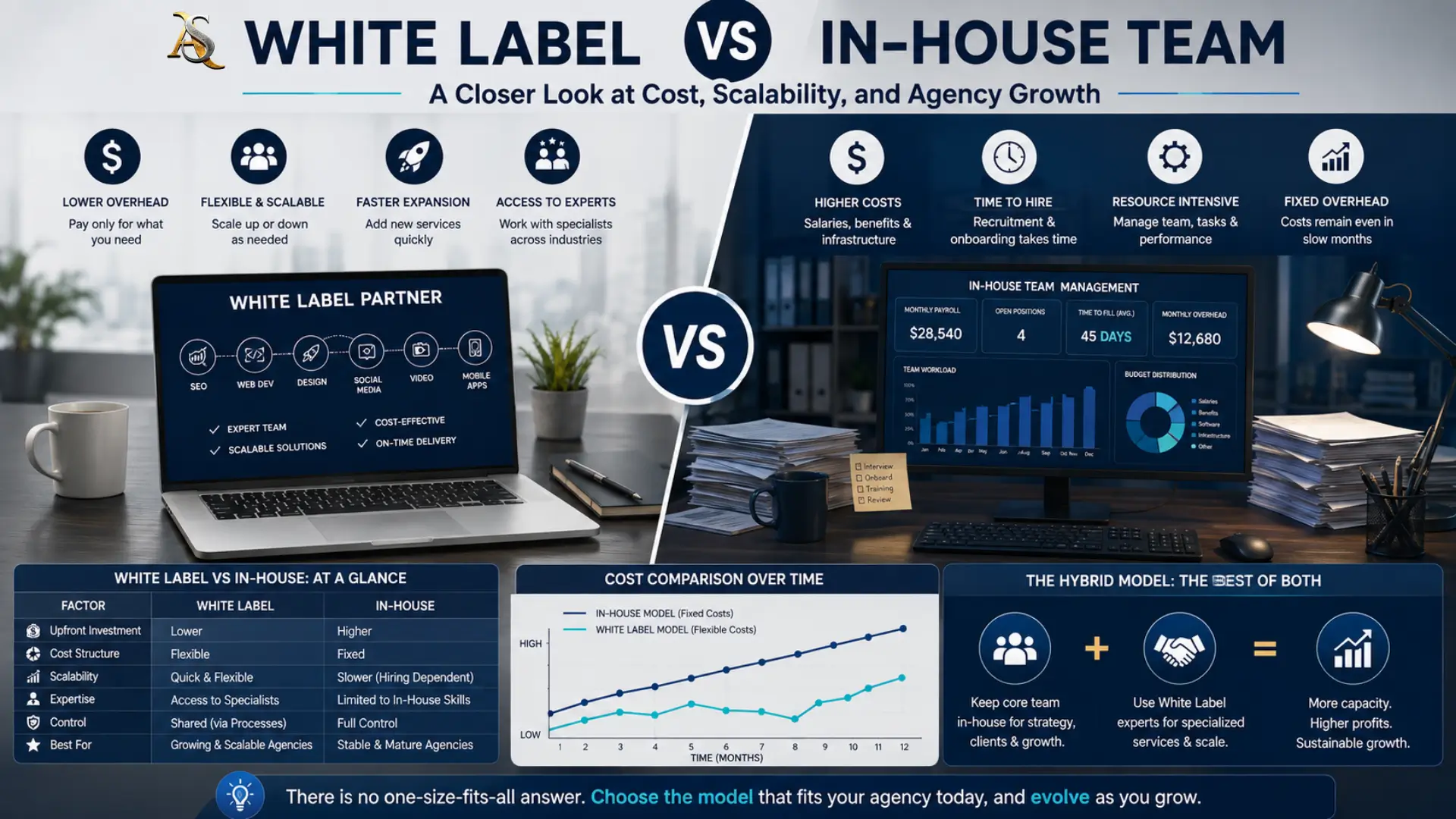
White Label vs In-House: A Closer Look at Cost, Scalability, and Agency Growth
Once an agency understands the basic difference between the White Label and in-house models, the next question becomes more practical:
Which approach creates the best opportunity for sustainable growth?
The answer depends on how your agency operates, the services you offer, and how predictable your client demand is.
Both models have clear advantages. The key is understanding where each one creates value—and where it can create challenges.
The Biggest Advantages of White Label Services
White Label partnerships give agencies the ability to expand their capabilities without immediately increasing internal headcount.
For growing agencies, this can create several important advantages.
1. Lower Fixed Overhead
Hiring an employee creates an ongoing financial commitment.
Even when client demand slows, your agency may still be responsible for:
- Salaries
- Benefits
- Software
- Training
- Equipment
- Management Costs
A White Label model can provide more flexibility because fulfillment resources can be aligned more closely with active client work.
This allows agencies to grow without taking on the same level of fixed operational costs associated with building a large internal team.
2. Access to Specialized Expertise
A modern marketing agency may need expertise across multiple disciplines.
For example:
- Technical SEO
- Content Strategy
- Website Development
- UI/UX Design
- Graphic Design
- Social Media Management
- Video Editing
- Mobile App Development
Hiring a highly experienced specialist for every service can become expensive.
A White Label partner can give your agency access to a broader range of skills without requiring you to build every department internally.
This makes it easier to respond when clients request services outside your existing capabilities.
3. Faster Service Expansion
Imagine a client asks your agency to provide mobile app development.
If you don’t currently have an internal development team, building one may involve:
- Defining the role
- Advertising the position
- Reviewing candidates
- Conducting interviews
- Negotiating compensation
- Onboarding employees
- Establishing new workflows
With the right White Label partner already in place, an agency may be able to add the service much faster.
This allows you to test new service offerings and respond to market demand without making a major hiring commitment before validating demand.
4. Greater Scalability
Client demand is rarely perfectly predictable.
One month, your agency may be managing a small number of projects.
The next, you may sign several large accounts at once.
White Label fulfillment can provide additional capacity when workloads increase.
This flexibility can help agencies handle growth opportunities without immediately going through another recruitment cycle.
Instead of building your internal team around your highest possible workload, you can maintain a leaner structure while using external fulfillment capacity when needed.
5. More Focus on Client Relationships
Agency owners and account managers often create the greatest value through:
- Business Development
- Client Communication
- Strategy
- Account Management
- Campaign Planning
- Relationship Building
When the entire leadership team is focused on recruitment, employee management, and production issues, less time is available for growth.
A reliable White Label partner can take on fulfillment responsibilities, allowing your internal team to spend more time on client-facing and strategic work.
6. Reduced Recruitment Pressure
Recruiting skilled professionals takes time.
Finding the right person can involve weeks or even months of searching, interviewing, and evaluating candidates.
There is also the risk that:
- The employee may not be the right fit.
- Work demand may change.
- The employee may leave unexpectedly.
- Additional recruitment may be required.
Working with an established White Label team can reduce some of this recruitment pressure because the provider is responsible for maintaining the specialists needed to deliver the work.
The Biggest Advantages of an In-House Team
White Label fulfillment offers flexibility, but an in-house team also provides significant advantages.
For agencies with stable demand and mature operations, internal teams can become a powerful long-term asset.
1. Direct Operational Control
With an in-house team, your agency has greater control over:
- Daily Workflows
- Internal Communication
- Training
- Processes
- Quality Standards
- Company Culture
Team members can work closely with one another and quickly adapt to internal priorities.
For agencies managing a high volume of similar work, this level of control can be extremely valuable.
2. Deep Understanding of Your Agency
Over time, internal employees develop a detailed understanding of:
- Your Services
- Your Processes
- Your Brand
- Your Clients
- Your Expectations
This institutional knowledge can make delivery more efficient.
An experienced internal team may anticipate client needs and understand how projects should be handled without requiring extensive explanations.
3. Stronger Collaboration
In-house teams can collaborate more closely across departments.
For example, a strategist can work directly with a designer, developer, and account manager throughout a project.
This can reduce communication gaps and create a more integrated workflow.
4. Long-Term Team Development
When demand is stable, investing in employees can strengthen your agency over time.
You can:
- Train specialists
- Develop leadership
- Build internal systems
- Create consistent processes
- Retain valuable knowledge
For established agencies with predictable workloads, this can justify the additional investment.
White Label vs In-House: The Direct Comparison
Factor | White Label Model | In-House Model |
Upfront Hiring Costs | Typically lower | Higher due to recruitment and onboarding |
Fixed Overhead | More flexible | Ongoing salaries and operating costs |
Scalability | Can expand capacity quickly with the right partner | Requires recruitment and onboarding |
Specialized Expertise | Access to broader specialist resources | Limited to current team capabilities |
Operational Control | Depends on communication and partnership quality | Greater direct control |
Company Knowledge | Partner learns your processes over time | Strong internal understanding |
Service Expansion | Easier to test new services | Requires new hires or training |
Recruitment Responsibility | Managed by the provider for its own team | Managed directly by the agency |
Best For | Growing or flexible agencies | Agencies with stable, predictable demand |
Neither model automatically wins in every situation.
The right approach depends on your agency’s specific stage of growth.
How Each Model Affects Agency Profit Margins
Profitability is one of the most important considerations when deciding how to structure your agency.
With an in-house team, your margins can potentially improve when employees are consistently working at a healthy utilization level.
However, underutilized employees can quickly become expensive.
If you hire a full-time developer but only have enough work to keep them busy half the time, your agency is still carrying the full cost of that employee.
The challenge is maintaining a consistent balance between capacity and demand.
The White Label model works differently.
Instead of building fixed capacity in advance, agencies can often connect fulfillment costs more directly to the work being sold and delivered.
This can make it easier to protect cash flow during periods of fluctuating demand.
However, agencies still need to price their services correctly.
A successful White Label model depends on understanding:
- Fulfillment Costs
- Project Scope
- Revision Requirements
- Management Time
- Desired Profit Margin
- Client Value
The goal isn’t simply to find the cheapest fulfillment provider.
The goal is to build a delivery model that provides reliable quality while leaving enough margin for your agency to operate and grow.
A Real-World Agency Growth Scenario
Imagine a marketing agency with a small internal team.
The agency currently has:
- One Agency Owner
- One Account Manager
- One Designer
The team primarily offers branding and basic marketing services.
Then several clients begin asking for:
- SEO
- Website Development
- Social Media Management
- Video Content
The agency has two possible approaches.
Option One: Build Everything In-House
The agency begins hiring:
- An SEO Specialist
- A Web Developer
- A Social Media Manager
- A Video Editor
The agency now has significantly greater capabilities.
However, it also has:
- Higher Monthly Payroll
- Recruitment Costs
- Training Requirements
- Additional Management Responsibilities
- Pressure to maintain enough client work for every employee
If new business is consistent, this model may eventually work well.
But if demand fluctuates, the agency could find itself carrying significant overhead.
Option Two: Use White Label Fulfillment
The agency maintains its client-facing team while partnering with experienced specialists behind the scenes.
The agency focuses on:
- Sales
- Client Communication
- Strategy
- Project Coordination
- Quality Review
The White Label partner supports:
- SEO Fulfillment
- Website Development
- Social Media Execution
- Video Production
This allows the agency to offer a broader range of services without immediately building four separate internal departments.
As demand becomes more predictable, the agency can decide which roles make sense to eventually bring in-house.
The Hybrid Model: Combining the Best of Both
For many growing agencies, the smartest approach may not be choosing exclusively between White Label and in-house.
A hybrid model can combine the strengths of both.
For example, an agency might keep these roles internally:
- Sales
- Account Management
- Strategy
- Client Success
- Project Management
These functions are closely connected to the agency’s relationships and brand experience.
The agency can then use White Label specialists for services that require specific technical expertise or additional production capacity.
This might include:
- Technical SEO
- Website Development
- Mobile App Development
- Video Editing
- Graphic Design
- Social Media Management
This structure allows the agency to maintain control over the client experience while remaining flexible in how work is delivered.
It also creates a clear path for growth.
As demand for a particular service becomes stable and predictable, the agency can evaluate whether bringing that capability in-house makes financial and operational sense.
The Hidden Cost of Growing Too Quickly
One of the biggest mistakes agencies make is assuming that growth always means hiring more people.
But rapid hiring can create its own problems.
If an agency builds a large team before revenue becomes stable, it may face:
- Cash Flow Pressure
- Underutilized Employees
- Higher Management Complexity
- Increased Recruitment Costs
- More Operational Risk
Growth should be supported by a structure that matches the agency’s actual demand.
White Label fulfillment can provide a useful buffer during this stage by giving agencies access to additional capacity without requiring them to permanently increase payroll for every new opportunity.
The goal is not to remain small.
The goal is to build an organization that can grow sustainably.
Which Model Is Better for Your Agency?
There is no universal answer.
An established agency with years of predictable demand may benefit significantly from building a strong internal team.
A growing agency entering new service areas may benefit more from the flexibility and specialized expertise of a White Label partner.
For many agencies, the answer will change over time.
A business might begin by using White Label fulfillment to expand its services and test demand.
As certain services become consistently profitable, it may bring selected roles in-house.
This creates a flexible growth path rather than forcing the agency to choose one model permanently.
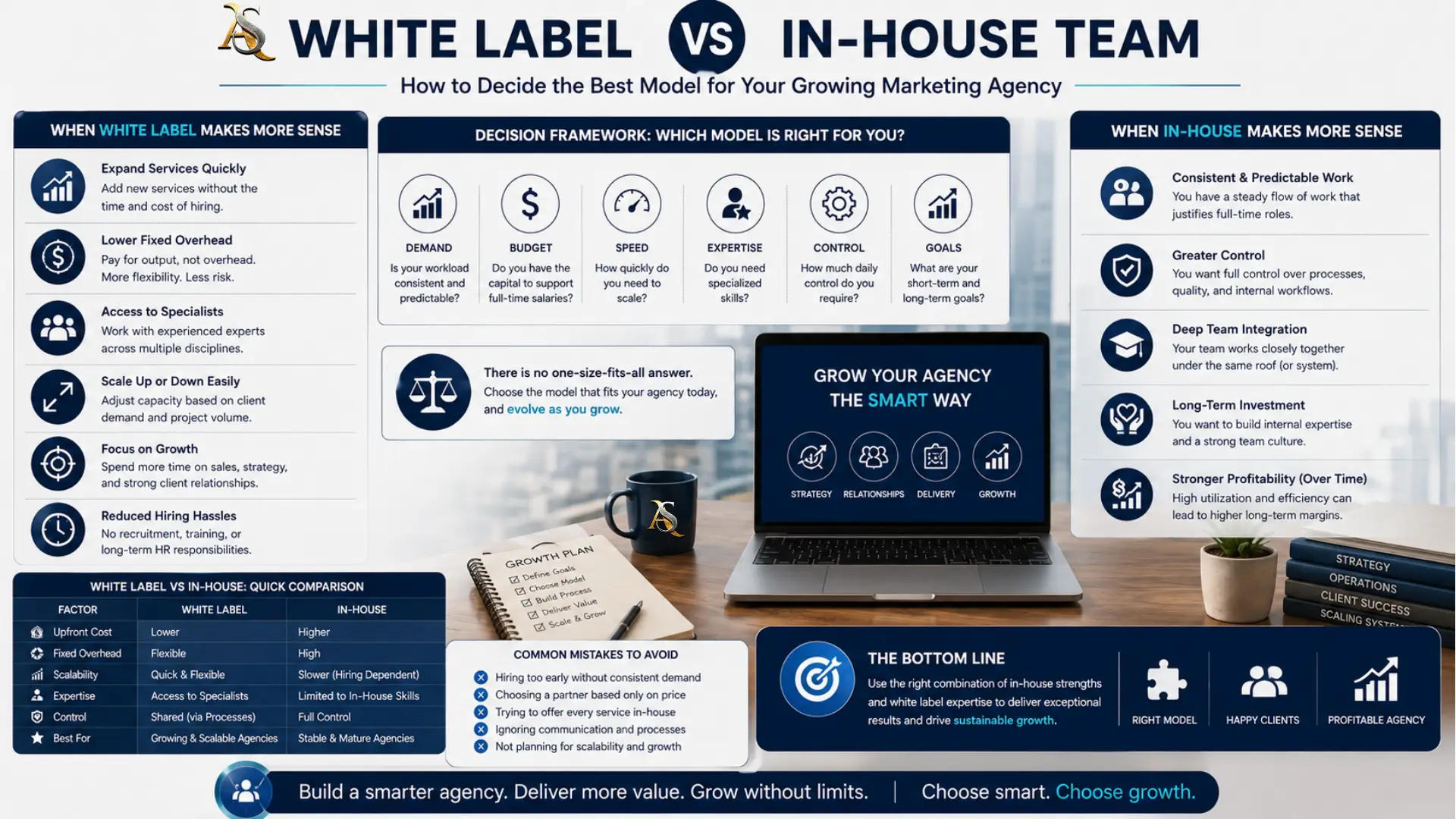
How to Decide Between White Label and In-House Teams
After comparing costs, expertise, scalability, control, and profitability, the next step is making the right decision for your agency.
There is no single answer that works for every business.
The best model depends on where your agency is today and where you want it to go next.
Instead of asking, “Is White Label better than in-house?”, ask:
“Which model gives my agency the strongest opportunity to grow sustainably right now?”
The following framework can help you make that decision.
1. Evaluate Your Current Demand
Start by looking at how consistent your workload is.
Ask yourself:
- Do we have a predictable volume of work every month?
- Are certain services consistently in demand?
- Do workloads fluctuate significantly?
- Are we turning away projects because of limited capacity?
- Do we have enough recurring revenue to support additional employees?
If demand for a particular service is stable and predictable, hiring internally may eventually make sense.
If demand changes frequently or you are still testing a service, White Label fulfillment can provide greater flexibility.
The goal is to avoid hiring based solely on expected growth before that demand has actually been established.
2. Understand the True Cost of Hiring
When comparing an employee’s salary with the cost of a White Label partner, it is important to look beyond the basic monthly wage.
The actual cost of building an in-house team may include:
- Recruitment
- Onboarding
- Training
- Employee Benefits
- Software
- Equipment
- Management Time
- Paid Leave
- Performance Management
- Employee Turnover
These costs can add significantly to the total investment required to build an internal department.
Before hiring, agencies should calculate whether there is enough consistent work to justify the full cost of maintaining that role.
3. Consider How Quickly You Need to Scale
Speed matters when opportunities arise.
Imagine your agency wins several large projects within a short period.
Can your current team handle the additional workload?
If not, how quickly can you realistically recruit and onboard the required specialists?
White Label partnerships can provide additional delivery capacity without requiring the agency to complete a full recruitment process every time demand increases.
For agencies operating in fast-moving markets, this flexibility can become a significant competitive advantage.
4. Identify Your Core Strengths
Not every function needs to be handled internally.
Consider where your agency creates the most value.
For many agencies, core strengths include:
- Sales
- Client Relationships
- Strategy
- Account Management
- Creative Direction
- Business Development
Technical production may require a different set of specialized skills.
A strong agency structure focuses internal resources on the areas where the business provides the greatest strategic value while ensuring the remaining work is delivered by qualified professionals.
5. Think About Your Long-Term Goals
Your current situation matters, but your future direction matters too.
Ask:
- Do we want to become a large full-service agency?
- Do we want to specialize in a specific service?
- Are we planning to expand into new markets?
- Do we want to remain lean while increasing revenue?
- Which services are becoming strategically important to our agency?
If you plan to build deep expertise around one service with consistently high demand, developing an internal department may support that goal.
If your priority is expanding capabilities while remaining operationally flexible, White Label fulfillment may be a stronger fit.
A Simple Decision Framework
Use this framework as a starting point:
White Label May Be the Better Choice If:
- Your agency is expanding into new services
- Demand is inconsistent or still developing
- You need specialized expertise
- You want to reduce fixed overhead
- You need to increase capacity quickly
- You want to test a service before hiring
- Your internal team is focused on sales and client management
- You want greater operational flexibility
In-House May Be the Better Choice If:
- You have consistent, predictable workloads
- A specific role is required continuously
- You have strong cash flow
- You want greater day-to-day operational control
- You are investing in long-term internal expertise
- You have the management capacity to support a larger team
A Hybrid Model May Be the Best Choice If:
- You want to maintain control over client relationships
- You have a strong internal leadership or account management team
- You need specialized production capabilities
- Your workload fluctuates across different services
- You want to scale without building unnecessary overhead
- You plan to gradually bring selected capabilities in-house
For many agencies, the hybrid model provides the flexibility to grow without forcing an all-or-nothing decision.
Common Mistakes Agencies Should Avoid
Choosing a delivery model can have a significant impact on profitability, client satisfaction, and long-term growth.
Here are some of the most common mistakes.
Hiring Too Early
One of the biggest mistakes is hiring employees based on expected future revenue rather than actual demand.
Hiring in anticipation of growth can create pressure if new business takes longer than expected.
A more sustainable approach is to build capacity around proven demand.
Choosing a White Label Partner Based Only on Price
The cheapest provider is not always the most profitable choice.
Low-quality work can result in:
- Client Dissatisfaction
- Missed Deadlines
- Excessive Revisions
- Reputation Damage
- Lost Clients
- Reduced Profit Margins
The value of a White Label partnership should be evaluated based on quality, reliability, communication, expertise, and scalability—not price alone.
Trying to Offer Every Service Internally
Agencies sometimes believe that becoming full-service means hiring specialists for every possible service.
This can create unnecessary complexity and overhead.
A more strategic approach is to determine which capabilities should become internal strengths and which can be supported by trusted external specialists.
Ignoring Communication Systems
Whether your team is internal or White Label, unclear communication can create problems.
Successful partnerships require:
- Clear Project Briefs
- Defined Responsibilities
- Realistic Timelines
- Revision Processes
- Regular Updates
- Quality Standards
A White Label partnership should feel like an extension of your internal operations, not a disconnected third party.
How to Evaluate a White Label Partner
Choosing the right White Label partner is critical.
The partner you select will directly affect the quality of work your clients receive and, ultimately, your agency’s reputation.
Before entering a partnership, consider the following.
Relevant Experience
Look for a provider with demonstrated experience in the services you plan to offer.
Review:
- Portfolio Examples
- Case Studies
- Industry Experience
- Technical Capabilities
- Previous Project Types
The goal is to ensure the provider has experience handling projects similar to those your clients will require.
Communication and Responsiveness
Strong communication is essential.
Your partner should have clear processes for:
- Receiving Project Briefs
- Providing Updates
- Asking Questions
- Managing Revisions
- Reporting Progress
- Escalating Issues
Poor communication behind the scenes can quickly become a client-facing problem.
Scalability
Your agency may only need a small amount of support today.
But what happens when your workload doubles?
Choose a partner with the resources and processes to support your growth without sacrificing quality.
Confidentiality and White Label Commitment
A genuine White Label partner understands the importance of remaining invisible.
The provider should respect your client relationships and operate according to clear confidentiality expectations.
Your agency should remain in control of the client-facing relationship.
Quality Control
Ask how the provider reviews work before delivery.
Reliable quality assurance processes help reduce:
- Errors
- Revisions
- Missed Requirements
- Delays
The best partners build quality control into their workflow rather than treating it as an afterthought.
FAQs
Is White Label better than hiring an in-house team?
Not necessarily. The best option depends on your agency’s workload, financial position, required expertise, and growth goals. Agencies with fluctuating demand may benefit from the flexibility of White Label services, while agencies with consistent demand for specific roles may benefit from building an in-house team.
Is White Label more cost-effective than hiring employees?
It can be, particularly when an agency does not yet have enough consistent work to justify full-time salaries and the additional costs associated with recruitment, training, software, and management. The financial comparison should consider total operating costs rather than salary alone.
Can an agency use both White Label and in-house teams?
Yes. Many agencies use a hybrid model, keeping client-facing and strategic roles in-house while using White Label specialists for technical services or additional production capacity.
When should an agency bring a service in-house?
It may make sense when demand for that service becomes consistent, predictable, and large enough to justify the full cost of recruiting, employing, and managing an internal specialist or team.
Will clients know that we use a White Label partner?
In a properly structured White Label relationship, the agency remains client-facing while the fulfillment partner works behind the scenes. Clear confidentiality processes and communication protocols are important when establishing the partnership.
Conclusion: Build the Model That Fits Your Agency
The White Label vs in-house decision should not be viewed as a permanent choice between two completely separate paths.
Your agency can evolve.
You may begin with White Label fulfillment to expand your services and manage fluctuating demand. As your revenue and workload become more predictable, you may decide to bring selected capabilities in-house.
Or you may continue operating with a hybrid structure that combines a strong internal client-facing team with specialized fulfillment partners.
The most important factor is building a model that aligns with your agency’s current resources, client demand, and long-term goals.
Growth does not always mean hiring more people.
Sometimes, smarter growth means building the right combination of internal expertise and scalable external support.
Ready to Scale Your Agency Without Unnecessary Overhead?
Aura Solution helps marketing agencies expand their service offerings with reliable White Label digital services delivered behind the scenes.
From SEO and website development to graphic design, social media management, video editing, website maintenance, and mobile app development, our team can become an extension of your agency’s delivery capabilities.
Partner with Aura Solution and build a flexible, scalable foundation for long-term agency growth.
Explore More
Blogs

Why Every Business Needs a Mobile-Friendly Website in 2025
As smartphone usage continues to dominate web traffic, businesses that neglect their mobile presence r
Aura Solution
June 15. 2025

How to Choose the Right Digital Marketing Partner in the USA
Choosing a digital marketing agency is a major decision for any business. With so many options, how do you find ....
Aura Solution
31 May 2025

Top Digital Marketing Strategies That Drive Results for US Businesses in 2025
As we move through 2025, digital marketing continues to evolve at a rapid pace. With increased competition
Aura Solution
15 May 2025