

POST BY

aura solution
PUBLISHED
September 17, 2026
CATEGORY
Development
aura solution
Web Developer
Introduction
Growing an agency is not only about increasing revenue.
An agency can win more clients, complete more projects, and generate higher sales while still struggling with profitability.
The reason is simple: revenue and profit are not the same thing.
As an agency grows, so can its expenses.
Hiring new employees, investing in software, managing additional projects, maintaining internal capacity, and handling periods of lower demand can all place pressure on profit margins.
This is one reason many agencies are exploring more flexible operating models.
A White Label partnership can allow an agency to access specialized services and additional fulfillment capacity without immediately taking on the fixed costs of expanding every department internally.
The result can be a more adaptable business structure that allows agencies to focus resources where they create the most value.
However, White Label services do not automatically make an agency more profitable.
The real benefit comes from using the model strategically.
In this guide, we’ll explore how White Label services can help agencies improve profit margins, manage costs more effectively, and build a scalable business model.
Understanding the Difference Between Revenue and Profit
Before looking at the White Label model, it is important to understand a common challenge in agency growth.
Imagine an agency increases its monthly revenue from $20,000 to $50,000.
At first, that sounds like significant growth.
But what happens if the agency’s expenses also increase dramatically?
For example, the agency may need to add:
- New Salaries
- Software Subscriptions
- Management Costs
- Office Expenses
- Equipment
- Training
- Recruitment Costs
- Employee Benefits
- Additional Administrative Support
Revenue may increase, but the agency’s actual profit margin may not improve at the same rate.
In some situations, an agency can become busier while becoming less efficient.
This is why profitable growth requires more than simply adding clients.
Agencies also need to consider how work is delivered and what each additional project costs the business.
The Challenge of Fixed Overhead
Traditional agency growth often follows a familiar pattern.
A new client creates additional demand.
The agency needs more capacity.
The agency hires another employee.
As demand increases again, another employee may be required.
While building an in-house team can offer important advantages, it also creates fixed financial commitments.
Those costs continue even when:
- Client demand slows
- A major project ends
- A client pauses services
- Revenue fluctuates
- Seasonal demand changes
For agencies with predictable and consistent demand, this structure may work well.
But for agencies experiencing changing workloads, fixed overhead can reduce flexibility.
This is where White Label fulfillment can offer an alternative.
Instead of building permanent internal capacity for every possible service, agencies can access external specialists when the work requires it.
How White Label Services Create More Flexibility
A White Label model allows agencies to separate the client-facing side of the business from some or all of the technical fulfillment work.
Your agency may focus on:
- Sales
- Strategy
- Client Relationships
- Project Management
- Account Management
- Quality Control
- Business Development
Meanwhile, a White Label partner can support areas such as:
- SEO
- Website Development
- Website Maintenance
- Graphic Design
- Social Media Management
- Video Editing
- Mobile App Development
This structure can give agencies more flexibility when managing demand.
Instead of asking:
“Do we need to hire another full-time specialist?”
The agency may be able to ask:
“Do we have the right fulfillment capacity for this project?”
That difference can have a significant impact on how costs are managed.
Reduce the Cost of Building Every Department
Offering multiple services can be attractive to clients.
However, delivering those services internally can require a large and diverse team.
For example, an agency that wants to provide:
- SEO
- Web Development
- Graphic Design
- Social Media
- Video Editing
may require specialists with very different skills.
Building every department internally can involve:
- Recruitment
- Salaries
- Training
- Management
- Software
- Equipment
- Employee Benefits
- Ongoing Payroll
A White Label partner can give an agency access to some of these capabilities without requiring every specialist to become a permanent internal hire.
This does not mean an agency should never build an in-house team.
Instead, it allows the agency to decide where internal investment makes the most strategic sense.
Turn Fixed Costs Into More Flexible Costs
One of the potential advantages of White Label fulfillment is the ability to make certain costs more closely connected to actual client demand.
With a large internal team, the agency may have significant monthly payroll commitments regardless of how much work is currently available.
With a flexible fulfillment model, some costs may increase or decrease alongside the volume of client work.
For example:
More projects → More fulfillment capacity
Fewer projects → Lower fulfillment requirements
This can help agencies manage periods of growth and slower demand more efficiently.
The goal is not simply to spend less.
The goal is to create a cost structure that better reflects the actual needs of the business.
Expand Your Service Offering Without Expanding Overhead at the Same Rate
Clients often prefer working with agencies that understand their broader digital needs.
A business that hires an agency for a new website may later need:
- SEO
- Website Maintenance
- Graphic Design
- Social Media Management
- Video Editing
If an agency can support these additional requirements, it may have opportunities to increase the value of each client relationship.
However, expanding services internally can be expensive.
White Label partnerships can make it possible to introduce additional capabilities without immediately creating a new department for every service.
This can help agencies:
- Respond to more client opportunities
- Increase the range of services offered
- Create service packages
- Develop additional revenue streams
- Provide more long-term support to clients
The key is to expand strategically.
Offering more services only makes sense when the agency has reliable fulfillment and clear processes for managing delivery.
Increase Revenue From Existing Clients
One of the most efficient growth opportunities for an agency may already exist within its current client base.
If you already have a strong relationship with a client, you understand:
- Their business
- Their goals
- Their challenges
- Their existing digital presence
This can make it easier to identify additional services that could provide genuine value.
For example, a website development client may later benefit from ongoing website maintenance.
An SEO client may need graphic design support for content or campaigns.
A social media client may benefit from video editing.
White Label fulfillment can make it easier to support these additional needs without requiring the agency to employ every specialist internally.
This creates an opportunity to increase revenue per client while continuing to build long-term relationships.
Improve Capacity Without Rushing Into Recruitment
Recruitment can be expensive and time-consuming.
Finding the right person may involve:
- Advertising the position
- Reviewing applications
- Conducting interviews
- Negotiating compensation
- Onboarding
- Training
There is also the challenge of hiring ahead of demand.
An agency may recruit a specialist because it expects future work to increase.
But if that demand does not develop as expected, the agency is still responsible for the associated employment costs.
A White Label model can provide an alternative source of capacity while the agency evaluates long-term demand.
For example, if website development projects begin increasing consistently, an agency can initially use White Label fulfillment to manage the workload.
Over time, if demand becomes predictable and strategically important, the agency can decide whether bringing part of that capability in-house makes financial sense.
This allows growth decisions to be based more on actual demand rather than assumptions.
Focus Internal Resources on Higher-Value Activities
Every agency has limited time and resources.
When leadership and internal teams become heavily involved in technical production, they may have less time available for activities that directly support business growth.
For example:
- Sales
- Business Development
- Client Relationships
- Strategy
- Partnerships
- Marketing
- Process Improvement
White Label fulfillment can allow agency owners and internal teams to focus more of their attention on these areas while experienced specialists support production.
This can be especially valuable for smaller agencies where the owner is responsible for multiple parts of the business.
The goal is to identify where your time creates the greatest value.
For some agencies, completing every task internally may be the right approach.
For others, focusing internal resources on client relationships, sales, strategy, and growth may create stronger long-term results.
Better Capacity Management Can Protect Profit Margins
One of the biggest challenges in agency operations is balancing available capacity with client demand.
Too little capacity can lead to:
- Missed Deadlines
- Employee Burnout
- Quality Issues
- Client Dissatisfaction
Too much unused capacity can lead to:
- Higher Overhead
- Lower Efficiency
- Reduced Profitability
A White Label partner can provide additional flexibility between these two extremes.
Instead of permanently expanding the internal team every time demand increases, agencies can potentially access additional fulfillment support when needed.
This can make it easier to manage:
- Short-Term Projects
- Seasonal Demand
- Unexpected Client Growth
- New Service Offerings
- Specialized Requirements
The more effectively an agency manages capacity, the easier it becomes to protect both quality and profitability.
Profitability Depends on More Than Lower Costs
It is important to understand that increasing agency profit margins is not simply about finding the cheapest fulfillment provider.
A low-cost provider that produces poor work can damage profitability through:
- Additional Revisions
- Project Delays
- More Internal Management Time
- Client Complaints
- Refunds
- Lost Clients
The goal should be to create an efficient delivery model that balances:
- Quality
- Cost
- Reliability
- Communication
- Scalability
The right White Label partner should reduce unnecessary operational pressure rather than create additional work for your team.
Build a More Scalable Cost Structure
As your agency grows, your operating model should be able to grow with it.
A structure that works for five clients may not work for fifty.
The White Label model can give agencies the flexibility to increase fulfillment capacity without needing to rebuild their entire internal organization every time demand changes.
This can allow growth to happen more gradually and strategically.
Instead of immediately increasing fixed costs, agencies can monitor:
- Client Demand
- Revenue
- Project Volume
- Profit Margins
- Service Performance
- Fulfillment Capacity
These insights can help determine when additional internal investment makes sense.
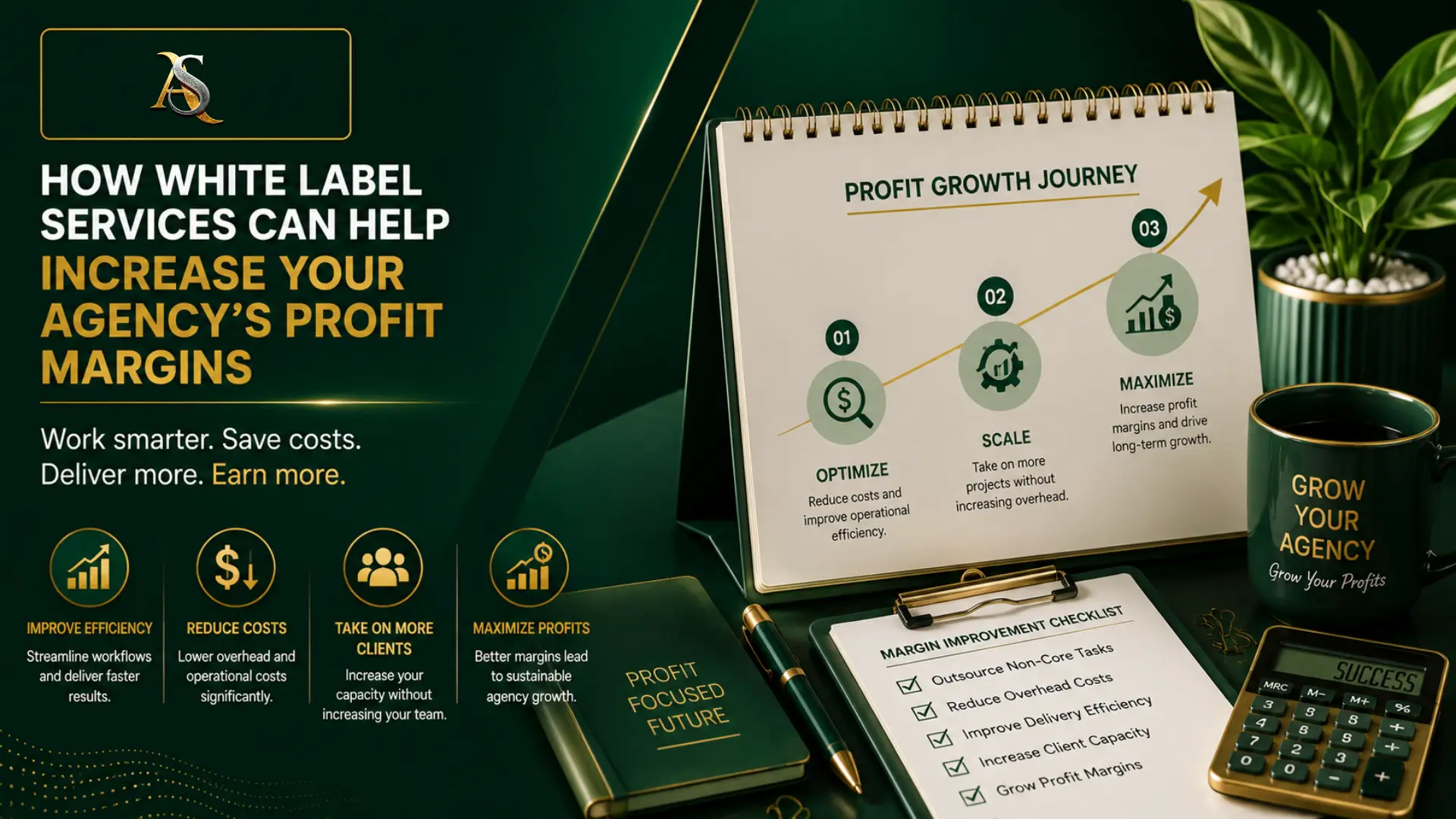
How to Use White Label Services to Build a More Profitable Agency
In Part 1, we explored how White Label services can help agencies create a more flexible cost structure, reduce the pressure of fixed overhead, expand their service offerings, and manage capacity more efficiently.
However, access to White Label fulfillment alone does not guarantee stronger profit margins.
An agency still needs to make smart decisions about pricing, packaging, fulfillment costs, recurring revenue, and operational efficiency.
The goal is not simply to sell a service for more than it costs to fulfill.
A profitable agency needs enough margin to support client management, sales, project coordination, software, marketing, quality control, and future growth.
In this section, we’ll look at how agencies can use White Label services strategically to create a healthier and more sustainable business model.
Understand Your True Cost Before Setting Prices
One of the biggest pricing mistakes an agency can make is looking only at the fulfillment cost.
For example, imagine your White Label partner charges $1,000 for a website project.
You might decide to add a 20% markup and charge the client $1,200.
On paper, that appears to create a $200 profit.
But your agency may also spend time and money on:
- Lead Generation
- Sales Calls
- Discovery
- Strategy
- Proposal Preparation
- Client Communication
- Project Management
- Quality Control
- Revisions
- Software
- Payment Processing
- Account Management
Once these costs are considered, the actual profit may be significantly lower.
Before setting your prices, understand the complete cost of delivering the service.
A simple way to think about it is:
Client Revenue − Total Cost of Delivery = Gross Profit
Your total cost of delivery should include both the fulfillment cost and the internal resources required to manage the client and project.
This does not mean you need a complicated financial model for every project.
But you should understand where your money and time are going.
Price Based on Value, Not Just Fulfillment Cost
Your fulfillment cost is important, but it should not be the only factor that determines your client pricing.
Clients are not simply paying for the behind-the-scenes production.
They may also be paying for:
- Your Expertise
- Strategy
- Communication
- Project Management
- Convenience
- Quality Assurance
- Accountability
- Ongoing Support
For example, two agencies may use similar fulfillment resources while charging very different prices.
One may position itself as a low-cost provider.
Another may offer a more strategic and high-touch experience.
The difference is not necessarily the fulfillment cost.
It can be the overall value the agency provides to the client.
Your pricing should reflect your positioning, the complexity of the work, the value being delivered, and the resources required to manage the relationship successfully.
Create Service Packages That Support Better Margins
Selling individual services can work well.
However, strategically designed service packages can make it easier to increase client value and create more predictable revenue.
For example, instead of offering only website development, an agency might create a broader package that includes:
- Website Development
- Search Engine Optimization
- Website Maintenance
- Graphic Design Support
Instead of requiring the client to purchase each service separately, the agency can present a more complete solution.
This approach can benefit both sides.
The client receives a coordinated service offering.
The agency has an opportunity to increase the overall value of the relationship.
Example: A Digital Growth Package
A monthly package could include:
- SEO
- Website Maintenance
- Graphic Design
- Performance Reporting
Example: A Content and Social Package
A package could include:
- Social Media Management
- Graphic Design
- Video Editing
- Content Planning
Example: A Website Growth Package
A package could include:
- Website Maintenance
- SEO Support
- Landing Page Updates
- Conversion Improvements
Packages should be based on real client needs.
The goal is not to add unnecessary services simply to increase the price.
A strong package should make it easier for the client to understand how different services work together.
Use Recurring Revenue to Create More Predictable Margins
One-time projects can generate valuable revenue.
However, relying entirely on project-based work can make agency income unpredictable.
A large project may finish, and the agency may immediately need to replace that revenue with another sale.
Recurring services can help create greater stability.
Examples may include:
- Monthly SEO
- Website Maintenance
- Social Media Management
- Ongoing Graphic Design
- Monthly Video Editing
- Digital Marketing Support
Recurring revenue can help agencies:
- Forecast future income
- Plan capacity more effectively
- Build longer client relationships
- Reduce dependence on constant new sales
- Create more predictable cash flow
White Label fulfillment can make recurring services especially flexible.
An agency may not need to build a full internal department before introducing a new recurring service.
Instead, it can work with a reliable fulfillment partner while focusing on building and managing the client relationship.
Increase the Value of Existing Client Relationships
Acquiring a new client often requires significant time and effort.
You may need to invest in:
- Marketing
- Advertising
- Networking
- Sales Calls
- Proposals
- Follow-Ups
This is why existing clients can represent an important growth opportunity.
If you already understand a client’s business and have established trust, it may be easier to identify additional services that provide genuine value.
For example:
A client using your agency for Website Development may need Website Maintenance.
A client using your agency for SEO may benefit from Graphic Design for campaigns and content.
A client using your agency for Social Media Management may benefit from Video Editing.
A client launching a new digital product may eventually need Mobile App Development.
White Label services can allow your agency to support these needs without requiring every capability to exist internally.
The focus should always be on identifying relevant opportunities.
Upselling should feel like a recommendation based on the client’s goals, not pressure to purchase additional services.
Protect Your Margins From Scope Creep
Scope creep can quietly reduce the profitability of a project.
A project may begin with a clearly defined list of deliverables.
Then additional requests begin appearing:
- “Can you make one more change?”
- “Can you add another page?”
- “Can you create a few additional graphics?”
- “Can we try another version?”
- “Could you also help with this?”
Individually, these requests may seem small.
Over time, however, they can significantly increase the amount of work required without increasing project revenue.
A clear scope of work is essential.
Before a project begins, define:
- Deliverables
- Number of Revisions
- Timeline
- Client Responsibilities
- Approval Process
- Additional Work Process
When a request falls outside the agreed scope, your agency should have a clear process for reviewing and pricing the additional work.
This protects your margins while also creating clearer expectations for the client.
Improve the Quality of Your Project Briefs
Poor communication at the beginning of a project can become expensive later.
If the White Label fulfillment team receives incomplete or unclear instructions, the result may be:
- Incorrect Deliverables
- Additional Revisions
- Project Delays
- More Internal Management Time
- Client Frustration
A strong brief can reduce these problems.
Include important details such as:
- Client Background
- Project Objectives
- Target Audience
- Deliverables
- Brand Guidelines
- Reference Examples
- Technical Requirements
- Timeline
- Important Restrictions
The goal is to give the fulfillment team the information needed to complete the work correctly the first time.
Better briefs can improve efficiency, reduce unnecessary revisions, and help protect profitability.
Build a Reliable Quality Control Process
Delivering work directly from a fulfillment partner to the client without review can create unnecessary risk.
Your agency is responsible for the final client experience.
Before presenting work to the client, review:
- Accuracy
- Brand Consistency
- Scope Requirements
- Technical Performance
- Content
- Visual Quality
- Client-Specific Instructions
Quality control may require additional time, but it can prevent larger problems later.
Finding an issue before the client sees it is usually easier than managing dissatisfaction, revisions, or a damaged relationship afterward.
As your agency grows, create a repeatable quality-control checklist for different types of projects.
This can make the process faster and more consistent.
Manage Fulfillment Costs Without Sacrificing Quality
Profitability does not mean choosing the cheapest possible provider.
A low-cost fulfillment partner may appear attractive initially but create additional costs through:
- Poor Quality
- Missed Deadlines
- Excessive Revisions
- Communication Problems
- Client Complaints
- Internal Management Time
The most profitable option is not always the provider with the lowest price.
Instead, evaluate the overall value.
Consider:
- Quality
- Reliability
- Communication
- Turnaround Time
- Revision Process
- Scalability
- Available Expertise
- Cost
A strong fulfillment partner should make your agency more efficient rather than creating additional work.
Standardize Repetitive Processes
As agencies grow, small inefficiencies can become expensive.
If your team starts every project from scratch, valuable time can be lost on repetitive administrative tasks.
Create templates and systems for:
- Proposals
- Discovery Calls
- Client Onboarding
- Project Briefs
- Status Updates
- Quality Control
- Revision Requests
- Monthly Reporting
Standardization does not mean every client receives an identical experience.
It means your agency has a reliable foundation for handling recurring tasks.
This allows your team to spend more time on work that requires expertise, strategy, and client-specific attention.
Know Which Services Are Actually Profitable
Not every service will produce the same margin.
An agency may generate significant revenue from one service while discovering that the amount of time required to manage it makes the actual profit relatively low.
Review your services regularly.
Look at:
- Revenue Generated
- Fulfillment Costs
- Internal Time Required
- Revision Volume
- Client Retention
- Profit Margin
- Opportunities for Expansion
You may discover that a smaller service offering creates stronger margins than a high-volume service that requires constant management.
These insights can help you make better decisions about where to focus your sales and marketing efforts.
Avoid Discounting Without a Clear Strategy
Discounting can sometimes be useful.
For example, you may offer a reduced rate as part of a larger package or long-term agreement.
However, frequent discounting can quickly affect margins.
Before reducing your price, ask:
- Will the project still be profitable?
- Does the discount support a larger opportunity?
- Is the client committing to a longer-term relationship?
- Can we reduce the scope instead of reducing the price?
In many cases, adjusting the scope may be more sustainable than simply lowering your price.
For example, instead of reducing the price of a monthly service package, you could create a smaller package with fewer deliverables.
This allows the client to choose an option that fits their budget while protecting your agency’s profitability.
Use White Label Services to Test New Opportunities
Launching a new service internally can require significant investment.
You may need to:
- Hire Specialists
- Purchase Software
- Develop Processes
- Train Employees
- Build Internal Capacity
But what happens if the demand is lower than expected?
White Label fulfillment can provide a lower-risk way to test new service opportunities.
For example, your agency may primarily focus on website development and SEO.
Several clients begin asking about video content.
Instead of immediately hiring a full-time video editor, you could introduce White Label Video Editing through a trusted fulfillment partner.
You can then evaluate:
- Client Demand
- Profitability
- Delivery Process
- Long-Term Potential
If demand grows consistently, you can decide whether to continue using White Label fulfillment, increase external capacity, or eventually bring some of the capability in-house.
This allows your agency to make investment decisions based on actual market demand.
Track the Numbers That Matter
Improving profit margins requires visibility.
You do not need to track every possible metric from the beginning.
But your agency should understand the numbers that directly affect profitability.
Monitor areas such as:
- Monthly Revenue
- Recurring Revenue
- Gross Profit
- Fulfillment Costs
- Client Acquisition Costs
- Average Revenue Per Client
- Client Retention
- Project Profitability
- Revision Volume
- Delivery Time
Over time, these numbers can reveal patterns that are difficult to see by simply looking at overall revenue.
For example, your agency may discover that one service has:
- High Revenue
- Low Retention
- Frequent Revisions
- Significant Management Time
Another service may generate less revenue per project but create:
- Strong Recurring Income
- Higher Retention
- Fewer Revisions
- Better Long-Term Margins
Understanding these differences can help guide future growth decisions.
Create a Balance Between Internal and White Label Resources
White Label services do not need to replace your internal team.
For many agencies, the strongest model may be a combination of both.
For example, your agency may keep certain strategic or client-facing roles internally while using White Label specialists for:
- Additional Capacity
- Specialized Skills
- New Service Categories
- Large Projects
- Temporary Demand
Over time, you can decide which capabilities should remain flexible and which are worth bringing in-house.
There is no single structure that works for every agency.
The right approach depends on your:
- Client Demand
- Revenue
- Growth Strategy
- Service Mix
- Internal Expertise
- Profitability Goals
The advantage of a flexible model is that you can adapt as your business evolves.

How to Build a More Profitable Agency With White Label Services
Increasing agency revenue is important, but sustainable growth depends on what remains after the costs of delivering that revenue are considered.
A profitable agency needs more than a steady flow of new clients.
It needs a business model that can manage changing demand, protect margins, maintain quality, and continue operating efficiently as the client base grows.
This is where White Label services can become a strategic part of an agency’s growth model.
The purpose is not simply to outsource work or find the lowest-cost provider.
The real opportunity is to build a flexible structure that gives your agency access to the skills and capacity it needs while allowing you to make better decisions about where to invest your internal resources.
In this final section, we’ll bring together the key principles discussed throughout this guide and create a practical framework for using White Label services to support long-term profitability.
A Practical Framework for Improving Agency Profitability
Every agency operates differently, but a profitable business generally requires control over several key areas.
These include:
- Revenue
- Fulfillment Costs
- Internal Expenses
- Pricing
- Capacity
- Client Retention
- Operational Efficiency
- Quality
White Label services can influence many of these areas, but only when they are integrated into a clear business strategy.
A useful approach is to evaluate your agency in five stages.
1. Understand Your Current Business Model
Before making major changes, understand how your agency currently generates revenue and where your resources are being used.
Review:
- Your Most Profitable Services
- Your Lowest-Margin Services
- Fulfillment Costs
- Internal Team Costs
- Client Retention
- Project Delays
- Revision Volume
- Unused Capacity
This process can reveal opportunities that are not immediately obvious.
For example, a service may generate significant revenue but require so much internal management that the actual margin is relatively low.
Another service may produce smaller individual projects but create predictable recurring revenue with fewer operational demands.
The goal is to understand the complete picture rather than making decisions based only on total revenue.
2. Identify Where White Label Support Makes Sense
Not every service needs to be outsourced.
Look for areas where White Label fulfillment could create additional flexibility or reduce unnecessary operational pressure.
For example:
- Services requiring specialized expertise
- New services you want to test
- Short-term increases in demand
- Projects that exceed internal capacity
- Services with inconsistent workloads
A White Label partner can provide additional support without requiring the agency to immediately create permanent internal capacity.
The decision should be based on the needs of your business rather than the assumption that outsourcing everything is automatically more profitable.
3. Build a Clear Pricing Model
Once you understand your costs, create pricing that supports sustainable margins.
Consider:
- Fulfillment Costs
- Internal Time
- Account Management
- Project Management
- Quality Control
- Software and Tools
- Sales and Marketing
- Revisions
- Desired Profit Margin
Your pricing should leave enough room for your agency to manage the client relationship and continue investing in growth.
If a service consistently creates very little profit after all costs are considered, increasing sales volume may simply increase the amount of work without significantly improving the business.
4. Create Repeatable Delivery Systems
Profitability can be affected by operational inefficiency.
If every project requires the team to reinvent the process, valuable time is lost.
Create repeatable systems for:
- Lead Qualification
- Client Discovery
- Proposals
- Onboarding
- Project Briefs
- Fulfillment
- Quality Control
- Revisions
- Client Reporting
- Project Delivery
The purpose of these systems is not to make every client experience identical.
It is to create a reliable structure that reduces unnecessary work and makes quality easier to maintain.
5. Review and Improve Continuously
Agency profitability should not be evaluated only once a year.
Review your business regularly.
Look for changes in:
- Client Demand
- Service Costs
- Project Volume
- Profit Margins
- Client Retention
- Delivery Performance
- Internal Capacity
As your agency changes, your delivery model may need to change with it.
A White Label structure can give you the flexibility to adapt without making every decision permanent.
How to Evaluate the Financial Impact of White Label Services
Before adding a new White Label service, evaluate the opportunity from a complete business perspective.
Ask:
What Will the Client Pay?
Start with the expected selling price.
Consider what clients in your target market are willing to pay and how your agency positions the service.
What Will Fulfillment Cost?
Understand the direct cost of working with your White Label partner.
Be clear about:
- Base Pricing
- Additional Services
- Revision Costs
- Rush Fees
- Ongoing Monthly Costs
How Much Internal Time Is Required?
Estimate the time your team will spend on:
- Sales
- Discovery
- Strategy
- Client Communication
- Project Management
- Quality Review
- Reporting
Even if the technical work is completed externally, internal time still has value.
What Margin Will Remain?
After estimating the full cost of delivery, determine whether the remaining margin supports your business goals.
This does not need to be calculated perfectly from the beginning.
The important thing is developing visibility into the economics of each service.
Over time, you can compare expected profitability with actual results and improve your pricing or processes.
Common Profitability Mistakes Agencies Should Avoid
Focusing Only on Revenue
Higher revenue does not automatically mean a healthier business.
An agency can grow quickly while increasing:
- Payroll
- Fulfillment Costs
- Management Time
- Software Expenses
- Operational Complexity
Monitor both revenue and profitability.
Underpricing to Win Clients
Lower prices may help win business in the short term, but underpricing can create long-term pressure.
When margins are too small, your agency may struggle to invest in:
- Quality
- Client Support
- Better Systems
- Marketing
- Business Development
Competing only on price can also make it difficult to maintain healthy client relationships.
Choosing the Cheapest Fulfillment Provider
Low fulfillment costs can look attractive.
However, poor communication, missed deadlines, or low-quality work can create expensive problems later.
Evaluate the total impact of a provider on your agency.
A reliable partner that costs more may ultimately create better profitability if they reduce revisions, management time, and client issues.
Ignoring Internal Time
A project may appear profitable when only fulfillment costs are considered.
But if your team spends dozens of hours managing the project, the real margin may be much lower.
Track where your time is being spent.
Allowing Scope Creep
Uncontrolled revisions and additional requests can gradually eliminate the profitability of a project.
Use clear scopes, revision limits, and processes for additional work.
When Does It Make Sense to Bring a Service In-House?
White Label services can provide flexibility, but there may eventually be situations where internal investment makes sense.
Consider bringing a service in-house when:
- Demand is consistently high
- The workload is predictable
- Internal delivery could improve margins
- Faster collaboration is required
- The service is strategically important
- You have enough volume to justify a dedicated role
However, this should be based on real data.
For example, if your agency regularly sells a high volume of website development projects, calculate whether the total cost of external fulfillment is greater than the realistic cost of building and managing an internal capability.
Also consider the additional responsibilities of employment, management, training, software, and maintaining enough work to keep the team productive.
The decision should not be based solely on the belief that bringing work in-house is always cheaper.
A Hybrid Model Can Provide the Best of Both Approaches
For many agencies, the strongest model may combine internal expertise with White Label support.
Your internal team may focus on:
- Strategy
- Sales
- Client Relationships
- Account Management
- Quality Control
- Business Development
White Label partners can provide support for:
- Specialized Services
- Additional Capacity
- Large Projects
- New Service Categories
- Fluctuating Workloads
This creates flexibility.
You can maintain internal control over the areas most important to your agency while using external capacity where it provides the greatest operational benefit.
The balance can change as your business grows.
Key Metrics for Long-Term Profitability
To make better decisions, agencies should regularly monitor the numbers that influence financial performance.
Revenue
Track:
- Total Monthly Revenue
- Recurring Revenue
- Revenue by Service
- Revenue per Client
This helps identify where growth is coming from.
Profit Margin
Review profitability at both the agency and service level.
Look at:
- Fulfillment Costs
- Internal Labor
- Software
- Marketing
- Administrative Costs
Understanding these costs can help identify services that require pricing or process changes.
Client Retention
Long-term clients can provide more predictable revenue.
Monitor:
- Average Client Relationship Length
- Client Churn
- Renewal Rates
- Reasons Clients Leave
If clients consistently leave after a short period, investigate whether the issue relates to results, communication, pricing, or expectations.
Average Revenue Per Client
Increasing the value of an existing client relationship can sometimes be more efficient than constantly replacing clients with new ones.
Look for genuine opportunities to support clients with additional services.
Project Profitability
Not every project creates the same return.
Review individual projects to understand:
- Estimated vs. Actual Costs
- Time Required
- Revision Volume
- Fulfillment Expenses
- Final Profit
This information can improve future pricing decisions.
Delivery Performance
Profitability and operational performance are connected.
Monitor:
- On-Time Delivery
- Project Delays
- Revision Frequency
- Quality Issues
Operational problems can create hidden costs that reduce margins.
Choosing the Right White Label Partner
The right White Label partner should support your agency’s profitability without compromising your client experience.
Before committing to a partnership, evaluate:
- Quality of Work
- Experience
- Range of Services
- Communication
- Turnaround Times
- Revision Process
- Pricing
- Scalability
- Confidentiality
- Reliability
A test project can be useful before committing to a larger volume of work.
This allows you to evaluate the actual working relationship rather than relying only on a portfolio or sales conversation.
As your agency grows, your fulfillment partner should be able to grow with you.
A partner that works well for a small number of projects but cannot manage increased demand may eventually create a bottleneck.
Why Agencies Partner With Aura Solution
For agencies, profitability is not simply about reducing costs.
It is about creating a delivery model that allows the business to offer quality services, manage client relationships effectively, and grow without adding unnecessary operational pressure.
Aura Solution provides White Label support across multiple digital services, allowing agencies to access additional capabilities while maintaining their own client relationships and brand.
Our White Label services include:
- SEO
- Website Development
- Website Maintenance
- Graphic Design
- Social Media Management
- Video Editing
- Mobile App Development
This allows agencies to build service offerings around their clients’ needs without needing to immediately hire specialists for every capability.
Whether an agency needs support for a specific project, additional fulfillment capacity, or a broader range of digital services, the goal is to provide a reliable behind-the-scenes partnership that supports growth.
Frequently Asked Questions
Can White Label services really improve agency profit margins?
They can, when used strategically. White Label services may help agencies create a more flexible cost structure, access specialized expertise, and avoid some of the fixed costs associated with building every capability internally.
However, profitability still depends on pricing, fulfillment costs, internal management time, quality control, and operational efficiency.
Is White Label fulfillment cheaper than hiring employees?
Not always.
The best option depends on the volume and consistency of work, the service being delivered, internal management requirements, and the total cost of hiring and maintaining employees.
White Label fulfillment can be particularly useful when workloads fluctuate or specialized expertise is needed.
How should I price White Label services?
Start by understanding the full cost of delivering the service, including fulfillment, internal time, project management, account management, software, revisions, and other operating costs.
Then create pricing that reflects the value provided and supports your desired margin.
Can I use White Label services while building an internal team?
Yes.
Many agencies use a hybrid model where internal employees handle client-facing, strategic, or core services while White Label partners provide specialized skills or additional capacity.
What services work well with a White Label model?
Depending on the fulfillment partner, agencies may use White Label support for SEO, website development, website maintenance, graphic design, social media management, video editing, mobile app development, and other specialized digital services.
How can I prevent White Label costs from reducing my margins?
Track the complete cost of each service, establish clear scopes of work, manage revisions, create strong project briefs, review project profitability, and work with reliable fulfillment partners.
When should an agency bring a service in-house?
Consider it when demand is consistent and predictable, the service is strategically important, and the financial analysis shows that internal delivery would provide a meaningful advantage.
Final Thoughts
Building a more profitable agency is not about cutting every possible cost.
It is about understanding where your resources create the most value.
White Label services can provide agencies with an opportunity to access specialized expertise and flexible fulfillment capacity without immediately building every department internally.
But the model works best when supported by:
- Sustainable Pricing
- Reliable Fulfillment
- Clear Project Scopes
- Strong Client Communication
- Quality Control
- Repeatable Systems
- Regular Financial Review
The goal is to build an agency that can grow without allowing costs and complexity to grow faster than revenue.
Start by understanding your current business model.
Identify where additional flexibility would be valuable.
Monitor the profitability of your services.
Improve inefficient processes.
And make long-term hiring and investment decisions based on actual demand.
With the right structure and the right fulfillment support, agencies can create a more adaptable model that supports both growth and long-term profitability.
Explore More
Blogs

Why Every Business Needs a Mobile-Friendly Website in 2025
As smartphone usage continues to dominate web traffic, businesses that neglect their mobile presence r
Aura Solution
June 15. 2025

How to Choose the Right Digital Marketing Partner in the USA
Choosing a digital marketing agency is a major decision for any business. With so many options, how do you find ....
Aura Solution
31 May 2025

Top Digital Marketing Strategies That Drive Results for US Businesses in 2025
As we move through 2025, digital marketing continues to evolve at a rapid pace. With increased competition
Aura Solution
15 May 2025