

POST BY

aura solution
PUBLISHED
September 15, 2026
CATEGORY
Development
aura solution
Web Developer
Introduction
For many US digital agencies, web development is one of the most valuable services they can offer clients. It can also become one of the most challenging services to deliver consistently.
A growing agency may have strong sales, strategy, SEO, design, and account management capabilities but still face a common problem: there are not enough developers available to handle every project.
Hiring a full time development team can take time and create significant ongoing costs. At the same time, turning away website projects can mean losing valuable revenue and client relationships.
This is why many agencies consider outsourcing web development to a specialized development partner.
With the right process, outsourcing can allow an agency to expand its web development capabilities, take on more projects, access specialized technical expertise, and maintain its client relationship without building a large development department internally.
The key is choosing the right outsourcing model and establishing a process that protects quality, communication, security, timelines, and agency profitability.
What Does Web Development Outsourcing Mean for Digital Agencies?
Web development outsourcing means hiring an external development team or company to handle some or all of the technical work required to build and maintain websites.
For a digital agency, the relationship can work in several ways.
The agency may:
- Sell the website project to its client
• Manage the client relationship
• Define the project strategy and scope
• Provide design files and content
• Coordinate approvals
• Review the development work
• Deliver the finished website under its own brand
The outsourced development team handles the technical production according to the agency’s requirements.
When the arrangement is white label, the development partner works behind the agency’s brand.
This allows the agency to offer web development without necessarily building a large internal development department.
Why Are US Digital Agencies Outsourcing Web Development?
There is no single reason agencies outsource development.
Different agencies use outsourcing for different business needs.
Limited Internal Development Capacity
An agency may already have developers but not enough capacity for a sudden increase in projects.
For example, an agency may have five active website projects and suddenly sign three additional clients.
Hiring additional developers may not be practical if the increased workload is temporary.
An external development partner can provide additional capacity while the agency evaluates whether long term hiring is necessary.
Access to Specialized Skills
Web development is a broad field.
A project may require experience with:
- WordPress
• WooCommerce
• Shopify
• Custom PHP development
• JavaScript
• React
• API integrations
• Ecommerce functionality
• Performance optimization
• Technical SEO
• Third party integrations
An agency may not have every skill internally.
Outsourcing can provide access to specialists when those capabilities are required.
Faster Project Delivery
A dedicated development team can sometimes help agencies handle projects without waiting for internal resources to become available.
However, speed should never come at the expense of quality.
The objective should be efficient and predictable delivery, not simply completing a website as quickly as possible.
Lower Operational Complexity
Building an internal development department involves recruitment, management, software, equipment, training, and ongoing workforce costs.
Outsourcing can allow an agency to access development capacity without managing every aspect of an internal technical department.
Ability to Offer More Services
An agency that primarily provides SEO, PPC, social media, branding, or marketing strategy may receive requests for websites.
Rather than referring those clients to another company, the agency can add web development to its service portfolio through an outsourcing or white label arrangement.
This can create additional revenue opportunities within existing client relationships.
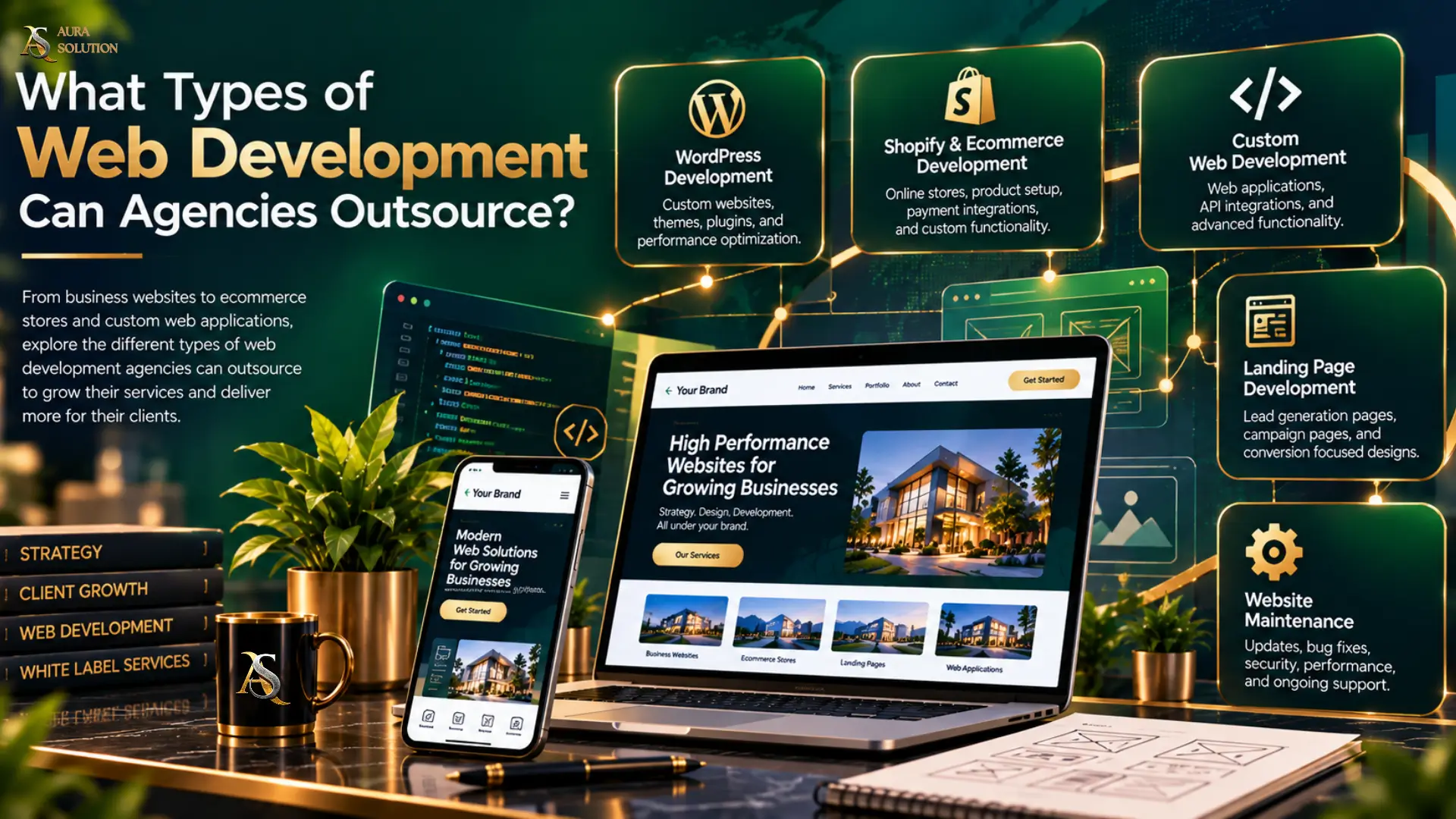
What Types of Web Development Can Agencies Outsource Aura Solution.png
What Types of Web Development Can Agencies Outsource?
The right outsourcing partner depends on the type of websites and technical services the agency sells.
WordPress Development
WordPress is widely used for business websites, service websites, content driven websites, and many agency projects.
Outsourced WordPress development may include:
- Custom website development
• Theme customization
• Elementor development
• Custom functionality
• Plugin configuration
• Plugin integrations
• Website migration
• Performance optimization
• Security improvements
• Website maintenance
Ecommerce Development
Ecommerce projects can require more complex functionality than standard brochure websites.
Agencies may outsource:
- WooCommerce development
• Shopify development
• Product setup
• Payment integrations
• Shipping integrations
• Custom ecommerce functionality
• Conversion focused improvements
• Third party integrations
• Ecommerce maintenance
Custom Web Development
Some clients require functionality that cannot be achieved through standard website builders.
Custom development may involve:
- Custom applications
• API integrations
• Database functionality
• Customer portals
• Business dashboards
• Custom forms
• Automation
• Third party software integrations
Landing Page Development
Landing pages are often needed by marketing agencies running campaigns.
A development partner can help agencies create:
- Lead generation landing pages
• Campaign landing pages
• Product landing pages
• Service landing pages
• Location pages
• Conversion focused landing pages
Website Maintenance
Development outsourcing does not have to end when the website launches.
Agencies can also offer ongoing:
- Website updates
• Bug fixes
• Plugin updates
• Content changes
• Performance improvements
• Technical troubleshooting
• Security support
• Feature updates
This can turn one time website projects into ongoing client relationships.
What Are the Benefits of Outsourcing Web Development?
1. Increase Development Capacity
The most immediate benefit is additional capacity.
An agency can use external developers when its internal team reaches capacity.
This can help the agency accept more projects without immediately hiring additional full time developers.
2. Expand Your Service Portfolio
An agency that does not currently offer development can add website services without building an entire development department.
This can be especially valuable for SEO and marketing agencies that frequently encounter clients who need website improvements.
3. Access Experienced Developers
A specialized development partner may have experience across multiple platforms, industries, and project types.
This can give an agency access to technical skills that would otherwise require additional recruitment.
4. Improve Resource Flexibility
Agency workloads fluctuate.
Some months may involve several website launches while others may be focused on SEO, campaigns, or client retention.
Outsourcing can give agencies additional flexibility during periods of increased development demand.
5. Support Larger Projects
A larger website project may require multiple specialists.
For example:
Project Requirement | Specialist |
UX Strategy | UX Specialist |
UI Design | UI Designer |
Front End | Front End Developer |
Backend | Backend Developer |
SEO | SEO Specialist |
Ecommerce | Ecommerce Developer |
Testing | QA Specialist |
Project Management | Project Manager |
A development partner with multiple capabilities can help an agency coordinate larger projects.
6. Give Internal Teams More Time
When developers are overloaded with production work, other areas of the agency can also be affected.
Outsourcing selected development work can allow internal teams to focus on:
- Strategy
• Client relationships
• Sales
• Business development
• Creative direction
• Project management
White Label Web Development vs Traditional Outsourcing
These terms are related but are not always identical.
Traditional outsourcing generally means an agency hires an external development provider to complete work.
White label web development goes further because the external provider works behind the agency’s brand.
The client may never interact directly with the development partner.
For agencies that want to maintain a consistent client experience, this distinction can be important.
A typical white label workflow looks like:
Agency wins client
↓
Agency defines project
↓
White label team receives requirements
↓
Development takes place
↓
Agency performs quality review
↓
Agency presents website to client
↓
Agency manages ongoing relationship
This model allows the agency to maintain ownership of the client relationship while using external development capacity.
How Does the Web Development Outsourcing Process Work?
A clear workflow is essential.
Step 1: Define the Client Requirements
Before sending a project to an external development team, document the requirements clearly.
This may include:
- Sitemap
• Design files
• Content
• Functionality
• Platform
• Integrations
• Required plugins
• SEO requirements
• Performance requirements
• Browser requirements
• Mobile requirements
• Deadline
The more clearly the requirements are documented, the less unnecessary back and forth will occur.
Step 2: Prepare the Technical Brief
The technical brief should explain exactly what needs to be developed.
Include:
- Page requirements
• Functionality
• Forms
• Integrations
• User flows
• Technical specifications
• Design references
• Development environment
• Testing requirements
Step 3: Development
The development team builds the website according to the approved requirements.
For larger projects, development can be divided into milestones.
Step 4: Internal Testing
The website should be tested before it reaches the client.
Testing may include:
- Desktop responsiveness
• Mobile responsiveness
• Tablet layouts
• Forms
• Links
• Navigation
• Browser compatibility
• Functionality
• Performance
• Basic SEO implementation
• Security considerations
Step 5: Agency Quality Assurance
The agency should conduct its own review.
This is important because the agency owns the client relationship.
The agency should not simply forward unfinished work to the client.
Step 6: Client Review
Once the agency approves the website internally, it can be presented to the client for feedback.
Step 7: Revisions
Client feedback should be collected systematically and sent to the development team as a consolidated revision list.
Step 8: Launch
After final approval, the website can be moved to the live environment.
Step 9: Ongoing Support
The agency can continue offering maintenance, SEO, development support, security, and other recurring services.
How Can Agencies Maintain Quality When Outsourcing Web Development?
Quality control should be established before the first project begins.
Review the Development Partner’s Portfolio
Look for projects similar to the websites your agency sells.
Do not only review screenshots.
If possible, examine live websites and evaluate:
- Design implementation
• Responsiveness
• Speed
• Functionality
• Navigation
• Mobile experience
• Technical execution
Establish a QA Process
The development team should have a defined quality assurance process.
The agency should also have its own final review process.
This creates two layers of quality control.
Use Development and Staging Environments
Websites should ideally be developed and tested in a controlled environment before being pushed live.
This reduces the risk of disrupting an existing production website.
Define Browser and Device Requirements
A website should be tested across relevant screen sizes and browsers.
The exact testing requirements should be established before development begins.
Document Revision Procedures
Unclear revision processes can create delays.
Define:
- How revisions are submitted
• Who reviews them
• How many revision rounds are included
• What qualifies as a new requirement
• How additional development is estimated
How Much Does It Cost to Outsource Web Development?
There is no universal outsourcing price.
The cost depends on:
- Website complexity
• Platform
• Number of pages
• Custom functionality
• Ecommerce requirements
• Integrations
• Design requirements
• Developer expertise
• Timeline
• Testing requirements
• Ongoing support
Agencies should avoid choosing a development partner based only on the lowest quote.
A low initial development cost can become expensive if the project requires extensive revisions, has quality problems, misses deadlines, or creates client management issues.
Instead, evaluate the total delivery cost.
This may include:
Development Cost + Project Management + QA + Revisions + Maintenance
The agency should then compare that total with the client price and desired margin.
How Can Agencies Protect Their Profit Margins?
Outsourcing web development only makes business sense when the agency maintains a sustainable margin.
Before accepting a project, calculate:
Client Project Price − Development Cost − Direct Project Costs = Gross Project Margin
For example, if a client pays $5,000 for a website and fulfillment costs $2,000, the gross project margin before other operating expenses is $3,000.
The actual profitability will depend on account management, sales costs, software, taxes, revisions, overhead, and other expenses.
Agencies should therefore avoid treating the development partner’s price as the only cost.
How Can Agencies Avoid Problems With Outsourced Developers?
Several common problems can be reduced through better processes.
Problem: Unclear Requirements
Solution: Create detailed project briefs before development begins.
Problem: Missed Deadlines
Solution: Establish milestones and delivery dates rather than relying only on one final deadline.
Problem: Too Many Revisions
Solution: Approve designs and functionality before development and clearly define the revision process.
Problem: Poor Communication
Solution: Establish a primary communication channel and response expectations.
Problem: Quality Issues
Solution: Use both development team QA and agency QA.
Problem: Client Confusion
Solution: Keep client communication centralized through the agency.
Problem: Scope Creep
Solution: Document the original scope and identify additional functionality separately.

How Should an Agency Choose a Web Development Partner?
The right development partner should be evaluated as a long term business relationship rather than simply a vendor.
Consider these factors:
Evaluation Area | What to Check |
Technical Expertise | Relevant platforms and development capabilities |
Portfolio | Quality of comparable projects |
Communication | Responsiveness and clarity |
Project Management | Ability to manage milestones |
QA | Defined testing procedures |
Security | Responsible access and data handling |
Scalability | Ability to support increasing workloads |
Turnaround | Realistic delivery timelines |
Revisions | Clear revision process |
Pricing | Sustainable cost structure |
White Label Experience | Ability to work behind an agency brand |
Support | Post launch assistance |
Questions to Ask a Web Development Partner
Before starting a partnership, agencies should ask:
What platforms do you specialize in?
The answer should match the platforms your clients commonly use.
Can you work from Figma designs?
This is particularly important for agencies that manage UI UX design internally.
Do you provide staging environments?
A staging environment can help agencies review changes before they reach production.
How do you handle revisions?
Understand the process before the first project.
What is your typical turnaround time?
Ask for realistic timelines based on different project sizes.
How do you handle urgent requests?
This matters when an agency has client deadlines or unexpected technical problems.
Do you provide ongoing maintenance?
This can create additional recurring service opportunities.
Can you work completely white label?
If the agency wants the partner to remain behind the scenes, clarify this from the beginning.
How do you handle client credentials and security?
Access to hosting, WordPress, ecommerce platforms, analytics, and other systems should be handled responsibly.
Can your team scale with our agency?
The partner should have sufficient capacity to support the agency as project volume increases.
How Can Agencies Turn Website Projects Into Recurring Revenue?
Website development can be the beginning of a longer client relationship.
After the website launches, an agency can offer relevant ongoing services such as:
Website Development
↓
Website Maintenance
↓
Technical SEO
↓
Ongoing SEO
↓
Landing Page Development
↓
Content and Creative Support
↓
Ongoing Development
This does not mean every client needs every service.
Instead, the agency can identify the client’s genuine ongoing requirements.
This approach connects Blog 15 directly with the recurring revenue strategy discussed in Blog 14.
Should Agencies Outsource All Web Development?
Not necessarily.
Many agencies use a hybrid model.
The agency may keep certain capabilities internally while outsourcing specific projects or overflow work.
For example:
Internal
- Strategy
• Client communication
• UI UX direction
• Project management
• Final QA
External
- WordPress development
• Custom development
• Ecommerce development
• Technical implementation
• Overflow development
The right balance depends on the agency’s size, technical capabilities, project volume, and long term strategy.
When Should an Agency Consider Outsourcing Web Development?
Outsourcing may be worth considering when:
- Your internal developers are consistently at capacity
• You are turning away website projects
• Your agency does not have development expertise
• Clients are requesting websites alongside marketing services
• You need specialized development skills
• Hiring developers is taking too long
• You need additional capacity for a large project
• You want to test web development as a new service
• You want to offer website maintenance without expanding your internal team
Frequently Asked Questions
What is web development outsourcing for digital agencies?
Web development outsourcing allows an agency to hire an external development team to complete website projects or specific technical tasks on behalf of the agency.
What is white label web development?
White label web development allows an agency to offer website development under its own brand while an external development team handles the technical fulfillment.
Is outsourcing web development good for small agencies?
Outsourcing can help small agencies access development expertise and increase delivery capacity without immediately building a large internal development team.
How can a marketing agency offer web development?
A marketing agency can partner with a web development company or white label development team and offer website development as part of its own service portfolio.
How much does it cost to outsource web development?
The cost depends on the platform, complexity, functionality, number of pages, integrations, timeline, development expertise, and ongoing support requirements.
How do agencies maintain quality when outsourcing development?
Agencies can maintain quality through detailed requirements, staging environments, development QA, agency QA, documented revisions, testing, and clear project management.
Can web development be white labeled?
Yes. A development team can work behind an agency’s brand while the agency maintains the client relationship, communication, strategy, and final approval.
Can outsourced web development increase agency revenue?
Outsourcing can give agencies additional capacity and allow them to offer web development to more clients. The financial result depends on pricing, fulfillment costs, client acquisition, retention, and operating expenses.
Should an agency hire developers or outsource development?
The decision depends on workload, project volume, budget, required expertise, and long term strategy. Some agencies use internal developers while outsourcing overflow or specialist projects.
Can outsourced website projects lead to recurring revenue?
Yes. Website projects can create opportunities for ongoing website maintenance, SEO, development support, landing pages, security, and other recurring digital services.
Final Thoughts
Web development can be a significant growth opportunity for digital agencies, but building a full internal development department is not always the right first step.
For US agencies, outsourcing can provide access to additional technical capacity while allowing the agency to remain focused on client relationships, strategy, sales, and business growth.
The most successful outsourcing relationships are built around more than development cost.
They depend on:
- Technical expertise
• Clear requirements
• Reliable communication
• Quality assurance
• Security
• Predictable timelines
• Transparent pricing
• Scalable capacity
• Strong project management
For agencies considering white label web development, the goal should be to create a delivery system that feels like an extension of the agency rather than a disconnected external vendor.
Aura Solution provides white label web development and digital fulfillment services for agencies, including website development, ecommerce development, website maintenance, SEO, UI UX design, mobile app development, creative services, and ongoing technical support.
Your agency maintains the client relationship and brand.
Our team supports the technical fulfillment behind the scenes.
If your agency is looking for a reliable white label web development partner, explore Aura Solution’s Agency Partnership program and discover how you can expand your development capabilities without building every technical role internally.
Explore More
Blogs

Why Every Business Needs a Mobile-Friendly Website in 2025
As smartphone usage continues to dominate web traffic, businesses that neglect their mobile presence r
Aura Solution
June 15. 2025

How to Choose the Right Digital Marketing Partner in the USA
Choosing a digital marketing agency is a major decision for any business. With so many options, how do you find ....
Aura Solution
31 May 2025

Top Digital Marketing Strategies That Drive Results for US Businesses in 2025
As we move through 2025, digital marketing continues to evolve at a rapid pace. With increased competition
Aura Solution
15 May 2025