

POST BY

aura solution
PUBLISHED
November 05, 2026
CATEGORY
Development
aura solution
Web Developer
Introduction
Digital agencies rarely struggle because they lack ideas or ambition. More often, the challenge is delivering excellent work consistently while managing multiple clients, competing deadlines, revisions, and changing priorities.
An agency might have a strong sales pipeline and a talented account management team, yet projects can still fall behind when website development, SEO, graphic design, video editing, or other services exceed the team’s available capacity. Hiring additional employees is one option, but it also introduces recruitment costs, training requirements, management responsibilities, and ongoing overhead.
White label fulfillment offers another approach. Agencies can work with a specialist delivery partner to complete services under their own brand while maintaining ownership of the client relationship.
However, outsourcing alone does not guarantee smoother delivery. Without a clear workflow, project briefs can be incomplete, responsibilities can overlap, approvals can be delayed, and deliverables can require unnecessary revisions.
A reliable white label delivery process defines how work enters the system, who is responsible for each stage, how quality is checked, and when the final deliverable is ready for the client.
For digital agencies looking to scale sustainably, building this process is just as important as choosing the right fulfillment partner.
What Is a White Label Delivery Process?
A white label delivery process is a documented workflow that enables a digital agency to outsource work to a specialist provider while delivering the completed service under its own brand.
The agency typically manages the client relationship, requirements, expectations, and commercial agreement. The fulfillment partner handles the agreed production or technical work according to the agency’s specifications.
Depending on the partnership, this arrangement can support website development, UI/UX design, web applications, mobile applications, SEO, local SEO, graphic design, video editing, social media management, and website maintenance.
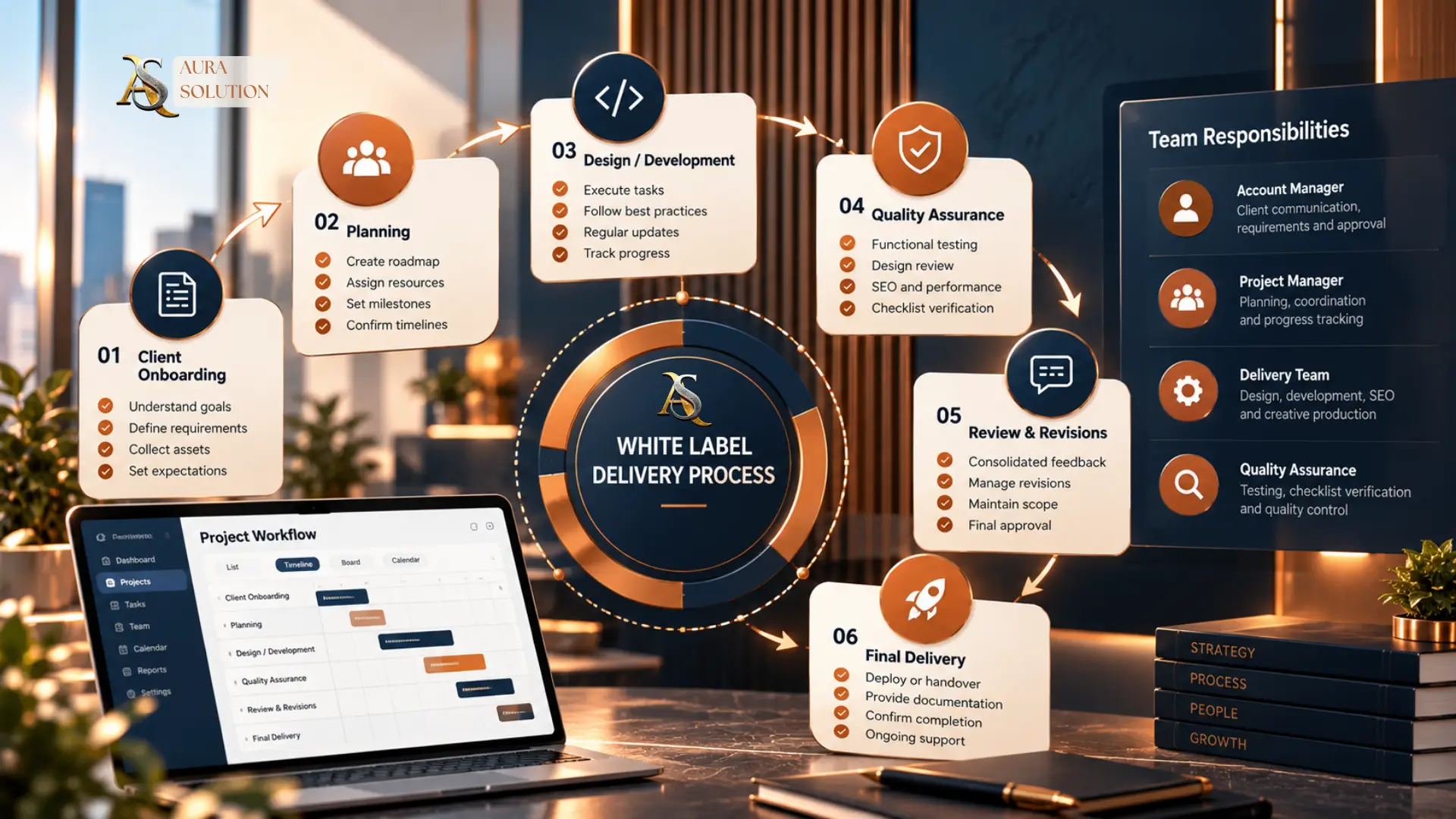
A structured process generally includes:
- Client requirement gathering and project qualification.
- Internal project briefing and scope confirmation.
- Assignment to the appropriate delivery specialist.
- Production, progress updates, and milestone reviews.
- Quality assurance and agency approval.
- Client presentation, feedback, and revisions.
- Final delivery, documentation, and project closure.
The exact workflow will depend on the service being delivered. A website development project requires technical testing and deployment checks, while an SEO engagement requires defined deliverables, reporting standards, and ongoing performance reviews.
The underlying principle remains the same: every project should move through an agreed process rather than depending on informal messages and individual memory.
Why Do White Label Projects Fall Behind Schedule?
When outsourced projects repeatedly miss deadlines, the problem is not necessarily the delivery partner. In many cases, the workflow itself creates avoidable delays.
1. Incomplete project briefs
A request such as “build a five page website” does not provide enough information for accurate delivery.
The team may still need to clarify the target audience, page structure, reference websites, content requirements, integrations, mobile behavior, approval process, and launch expectations.
When these details emerge during production, the project can expand beyond its original scope.
Solution: Create a standard project brief for each service category and confirm that all essential information is available before production begins.
2. Unclear ownership
If the agency account manager, internal designer, developer, and fulfillment partner all assume someone else is responsible for an approval, a task can remain unfinished even when everyone is working.
Solution: Assign one accountable owner for every task and identify who is responsible for reviewing, approving, and communicating each milestone.
3. Feedback scattered across multiple channels
Project instructions can become difficult to track when feedback is distributed across email, WhatsApp, project management tools, and separate documents.
A developer may implement an outdated instruction while the account manager believes a newer revision has already been shared.
Solution: Maintain one designated source of truth for project requirements, feedback, approvals, and status updates.
4. No defined quality assurance stage
When work moves directly from production to the client, preventable issues may appear in the final review. These could include broken links, mobile layout problems, inconsistent branding, missing metadata, or incomplete deliverables.
Solution: Introduce a documented quality assurance checklist before any deliverable is marked ready for agency review.
5. Unrealistic deadlines and uncontrolled scope
An agency may promise a delivery date before confirming the project’s complexity, dependencies, content availability, or required approval time.
Additional requests can then enter the project without a corresponding adjustment to the schedule or budget.
Solution: Confirm scope, dependencies, resource availability, and milestones before committing to a delivery date. Treat additional requirements as potential scope changes that must be assessed and approved.
How to Build a White Label Delivery Process Step by Step
A good workflow should be detailed enough to prevent confusion but simple enough for the team to follow on every project.
Step 1: Define the services and deliverables
Start by documenting exactly what the agency offers and what the fulfillment partner is expected to produce.
For example, a website development engagement might include:
- Website design implementation based on an approved design.
- Responsive layouts for desktop, tablet, and mobile.
- Agreed functionality and third party integrations.
- Basic technical checks and quality assurance.
- Deployment support, where included in the agreement.
- Handover documentation and agreed revision rounds.
An SEO engagement would require a different scope, potentially covering technical audits, on page optimization, local SEO tasks, content recommendations, and recurring reports.
Do not rely on broad descriptions such as “complete website development” or “full SEO support” without documenting the specific deliverables and exclusions.
A clearly defined scope gives the agency a stronger basis for estimating costs, setting client expectations, assigning work, and evaluating completion.
Step 2: Create a standard intake and briefing system
Every new project should enter the delivery workflow through a consistent intake process.
Capture the information needed to start work, including the business objective, target audience, deliverables, brand assets, access requirements, deadlines, dependencies, and approval contacts.
For example, a local SEO project might require the client’s business details, service areas, website access, Google Business Profile access where appropriate, and an agreed list of priorities.
A website project might require hosting information, the approved design, page content, brand assets, functional requirements, and details of existing integrations.
Use a readiness check before assigning the project.
If essential information is missing, identify the missing items and assign responsibility for collecting them. This prevents the production team from repeatedly stopping work to request basic information.
Step 3: Break the project into measurable milestones
Large projects are easier to manage when divided into stages with clear completion criteria.
For a website project, the workflow could be:
- Requirements and scope approved.
- Sitemap and design direction confirmed.
- Design or development completed according to scope.
- Internal quality assurance completed.
- Agency review and consolidated feedback.
- Revisions completed and approved.
- Final delivery or deployment completed.
- Handover and closure documented.
Each milestone should have an owner, an expected completion date, and a clear definition of what constitutes completion.
This also makes progress updates more meaningful. Instead of reporting that a project is “80% complete” without explanation, the team can identify which stages are finished, which remain open, and what is blocking progress.
Step 4: Establish communication and escalation rules
A reliable delivery process defines how people communicate, not just what they produce.
Agree on where project instructions are recorded, how often progress is reported, who can approve scope changes, and how urgent issues are escalated.
For example, the agency might receive a weekly project summary, while urgent technical blockers are reported as soon as they are identified.
The process should also clarify whether the fulfillment partner communicates directly with the end client or works exclusively through the agency. In a white label arrangement, this boundary should be explicitly agreed upon rather than assumed.
The objective is to create predictable communication without requiring the agency owner to supervise every production task personally.
Step 5: Build quality assurance into every project
Quality assurance should be a defined stage of the delivery process, not an informal check performed when someone has spare time.
The checklist must reflect the type of service being delivered.
For website development, review:
- Desktop and mobile responsiveness.
- Navigation, links, forms, and agreed functionality.
- Page loading behavior and visible layout issues.
- Required metadata, headings, and image alternative text.
- Browser compatibility and relevant technical requirements.
- Security considerations, backup arrangements, and deployment readiness where applicable.
For graphic design and video editing, review brand consistency, dimensions, resolution, file formats, spelling, and delivery specifications.
For SEO projects, review whether the agreed tasks have been completed, whether implementation is accurate, whether recommendations are documented, and whether reporting reflects the work performed.
Not every project requires the same checklist. A simple social media graphic should not go through the same technical review as a custom web application.
Create service specific checklists and make completion part of the formal handoff process.
Step 6: Introduce a clear review and revision cycle
Unstructured feedback is one of the most common causes of avoidable project delays.
Consider a website design project where three stakeholders provide separate feedback over several days. The designer may complete the first set of changes only to receive new instructions that conflict with earlier approvals.
A better process establishes:
- A designated agency reviewer.
- One consolidated set of feedback for each review round.
- A deadline for submitting feedback.
- A documented distinction between corrections and new requirements.
- A defined number of included revision rounds.
- A process for approving additional work.
For example, correcting a button that does not match the approved design is a correction. Adding a new booking system after the original scope has been approved is potentially a scope change.
This distinction protects the agency’s schedule and the fulfillment partner’s capacity while giving the client a transparent process.
Step 7: Manage capacity before accepting new work
An agency can have a reliable partner and still experience delivery problems if it assigns more work than the available team can handle.
Before committing to a deadline, review current assignments, project complexity, specialist availability, dependencies, and the time needed for internal review.
A simple capacity plan might include:
Workstream | Example allocation | Planning purpose |
Website development | 35 hours | Track active build capacity |
SEO and local SEO | 25 hours | Protect recurring delivery commitments |
Design and video | 20 hours | Schedule creative production |
Quality assurance and revisions | 10 hours | Reserve time for review and corrections |
These numbers are illustrative, not recommended industry benchmarks. An agency should adjust its allocation to match actual project requirements and available resources.
Avoid assigning every available hour to production. Leave appropriate capacity for reviews, unexpected technical issues, client feedback, and urgent requests.
For recurring engagements, review capacity regularly rather than waiting until a deadline is missed.
Step 8: Track delivery performance using meaningful metrics
A project management dashboard should help the agency identify problems early rather than simply display a list of tasks.
Useful metrics include:
Metric | What it reveals |
On time delivery rate | Whether projects meet agreed deadlines |
First review acceptance rate | How often work passes the agency’s initial review |
Average revision rounds | Whether briefs and quality checks are effective |
Project cycle time | How long work takes from an agreed start to completion |
Scope change frequency | Whether requirements are being controlled |
Blocked task duration | How long projects wait for information or decisions |
Client satisfaction | How clients perceive the delivered work and communication |
Use these metrics to identify patterns, not to assign blame automatically.
For instance, a low first review acceptance rate could indicate unclear briefs, inconsistent standards, insufficient internal review, or a mismatch between the agreed scope and the delivered work.
The agency and its fulfillment partner should review recurring problems together and agree on specific improvements.
Step 9: Create a consistent client handoff process
The fulfillment partner may complete the work, but the agency remains responsible for presenting it clearly to its client when that responsibility is part of the agency’s agreement.
A strong handoff includes the final deliverables, a concise summary of completed work, any relevant documentation, known limitations, outstanding items, and the next recommended action.
For a website project, this might include access details shared securely, deployment information, maintenance recommendations, and a list of completed features.
For an SEO engagement, it might include a summary of completed optimizations, outstanding recommendations, and the next reporting period.
The handoff should not leave the client wondering what was completed or what happens next.

A Practical Example: Managing a White Label Website Project
Imagine a US marketing agency wins a website development project for a local service business. The agency manages the client relationship, while a white label partner handles the agreed development work.
Without a documented workflow, the project might involve repeated requests for content, unclear design approvals, untracked revisions, and confusion over who is responsible for launch testing.
With a structured process, the agency can establish the following sequence.
Stage 1: Intake
The agency collects the approved scope, sitemap, design references, content, functionality requirements, access details, and launch deadline.
Stage 2: Project planning
The agency and fulfillment partner confirm the deliverables, milestones, dependencies, responsibilities, and review dates.
Stage 3: Production
The development team completes the agreed work and reports progress through the designated project management system.
Stage 4: Quality assurance
The team checks responsive behavior, links, forms, agreed functionality, and other project specific requirements.
Stage 5: Agency review
The agency reviews the work and submits consolidated feedback against the approved brief.
Stage 6: Final approval and handoff
The team resolves agreed corrections, confirms acceptance, and completes the documented handoff or deployment process.
The benefit is not that every project becomes identical. The benefit is that everyone knows what needs to happen next, who owns it, and how completion will be verified.
How to Choose a White Label Partner Who Can Follow Your Process
A delivery workflow is only effective when the people involved understand and follow it. Choosing the right fulfillment partner therefore requires more than comparing service lists or prices.
Before entering a partnership, evaluate the following areas.
Service expertise and delivery capability
Confirm that the provider has experience with the specific services your agency wants to outsource. A team experienced in WordPress development may not automatically be the right choice for complex mobile applications or advanced technical SEO.
Ask about relevant project experience, available specialists, quality assurance procedures, and the tools used to manage delivery.
Communication and accountability
Determine who will receive briefs, provide progress updates, flag blockers, and handle revisions.
You should know where to find the current project status and whom to contact when an issue requires attention.
Scope and pricing transparency
Confirm how deliverables are defined, what is included, how revisions are handled, and how additional requirements are priced.
The lowest quoted price is not necessarily the most economical option if incomplete work, repeated corrections, or unclear scope create additional management costs.
Confidentiality and client ownership
Discuss confidentiality, access permissions, data handling, intellectual property, and any restrictions on direct communication with your clients.
The agreement should make clear how the provider will represent your agency and protect the client relationship.
A controlled trial project
Where practical, start with a project of manageable scope. Evaluate communication, adherence to the brief, delivery quality, responsiveness to feedback, and the completeness of the handoff before expanding the relationship.
A trial helps both parties identify process gaps before a larger volume of work depends on the partnership.
How Can Agencies Make White Label Delivery More Efficient Over Time?
A documented process should evolve as the agency grows. The objective is not to add unnecessary administrative work. It is to remove repeated decisions, reduce avoidable errors, and make project delivery more predictable.
Standardize recurring tasks without eliminating flexibility
Create reusable templates for common project types, including website builds, SEO onboarding, monthly maintenance, graphic design requests, and video editing assignments.
Each template should define the essential inputs, deliverables, review steps, and completion criteria.
Keep room for service specific requirements. A local SEO campaign for a multi location business, for example, will need different inputs and checks from a single location campaign.
Automate routine administrative work
Automation can help agencies reduce manual follow ups and keep projects moving.
Useful opportunities include:
- Creating a project record when a new engagement is approved.
- Assigning standard tasks from a project template.
- Notifying the responsible person when a milestone is approaching.
- Requesting missing information before production starts.
- Reminding reviewers when feedback is due.
- Generating a recurring delivery summary for agency management.
Automation should support the agreed workflow rather than replace human judgment. A task should not automatically be marked complete simply because a deadline has passed or a notification has been sent.
Document recurring problems and their solutions
When the same problem appears repeatedly, improve the process instead of relying on the team to remember a workaround.
If content is frequently delivered late, add a content readiness checkpoint. If clients repeatedly request work outside the original scope, improve the proposal and approval process. If mobile layout issues recur, strengthen the relevant quality assurance checklist.
Over time, these small improvements can reduce unnecessary rework and make delivery easier to manage.
Common White Label Delivery Mistakes Agencies Should Avoid
Even agencies with experienced teams can undermine their delivery process through a few recurring mistakes.
Treating the fulfillment partner as a task taker
A good partnership requires clear requirements, timely decisions, useful feedback, and shared accountability. Sending vague instructions and expecting flawless execution creates unnecessary friction.
Promising deadlines before confirming feasibility
Sales commitments should reflect the agreed scope, current capacity, client dependencies, and approval requirements. Confirm feasibility before presenting a delivery date as final.
Changing requirements without updating the scope
New functionality, additional pages, extra design concepts, and expanded reporting can affect effort and delivery dates. Record changes and obtain approval before treating them as part of the original commitment.
Skipping internal review
The agency should verify that deliverables meet the agreed standards before presenting them to the client, unless the agreed workflow explicitly assigns that responsibility elsewhere.
Measuring success only by cost
Low fulfillment costs are useful only when the arrangement also meets quality, communication, deadline, and client service expectations.
A partner that helps the agency deliver consistently may create more business value than one that simply offers the lowest price.
Your White Label Delivery Process Checklist
Use this checklist when establishing or reviewing your agency’s workflow.
- Every service has a clearly defined scope and deliverables.
- Project briefs contain the information required to begin work.
- Each task has an accountable owner.
- Milestones have agreed completion criteria and deadlines.
- Communication takes place through designated channels.
- Quality assurance is documented for each service.
- Review rounds and scope changes are clearly managed.
- Team capacity is checked before new deadlines are committed.
- Project status and blockers are visible to the relevant people.
- Client handoffs include the agreed deliverables and documentation.
- Delivery metrics are reviewed for recurring problems.
- Confidentiality and client relationship boundaries are documented.
An agency does not need an elaborate operations department to implement these practices. It needs a repeatable process that fits its services, team size, client expectations, and partnership arrangements.
How Aura Solution Can Support Your White Label Delivery Workflow
Expanding an agency’s capabilities should not require the owner to personally manage every production task or immediately build a large in house team.
Aura Solution supports digital agencies with white label services across website development, web applications, mobile applications, UI/UX design, SEO, local SEO, website maintenance, graphic design, video editing, social media management, and related digital work.
For agencies serving US clients, a well defined fulfillment arrangement can provide access to specialist delivery capacity while allowing the agency to maintain its own brand and client relationships, subject to the agreed partnership terms.
The starting point is understanding how your agency currently operates. Which services consume the most time? Where do projects experience bottlenecks? Which capabilities do your clients request that your existing team cannot comfortably deliver?
Those answers help identify where an external delivery partner could add value.
If your agency is evaluating white label support, explore Aura Solution’s services and discuss the types of projects, delivery requirements, and ongoing capacity your team needs.
Build a delivery process that supports your clients, protects your team’s time, and gives your agency room to grow.
Frequently Asked Questions
What is a white label delivery process?
A white label delivery process is a structured workflow through which a digital agency outsources agreed services to a specialist provider and delivers the completed work under its own brand. It defines project intake, responsibilities, production, quality checks, approvals, revisions, and handoff.
How do agencies manage white label projects effectively?
Agencies can manage white label projects effectively by using complete project briefs, clearly assigned responsibilities, agreed milestones, centralized communication, documented quality checks, and a consistent review process. Regular capacity planning and early escalation of blockers also help prevent avoidable delays.
How can agencies maintain quality when outsourcing digital services?
Agencies should define service specific quality standards, review deliverables against the approved brief, consolidate feedback, and resolve agreed corrections before client handoff. Quality metrics and regular discussions with the fulfillment partner can help identify recurring problems.
Which digital services can agencies outsource through a white label partner?
Depending on the provider’s capabilities, agencies can outsource website development, web applications, mobile app development, UI/UX design, SEO, local SEO, website maintenance, graphic design, video editing, and social media management.
How do white label partners help agencies scale?
White label partners can provide access to specialist skills and additional delivery capacity without requiring the agency to recruit every specialist internally. The agency can then evaluate new service opportunities and workload while maintaining responsibility for its client relationships and commercial commitments.
What should an agency include in a white label project brief?
A project brief should document objectives, target audience, scope, deliverables, brand guidelines, required assets, technical requirements, deadlines, dependencies, approval contacts, revision rules, and completion criteria. Access credentials should be shared securely rather than embedded in ordinary project notes.
How should agencies handle scope changes in outsourced projects?
Agencies should document the requested change, assess its effect on cost, workload, and delivery dates, and obtain approval before proceeding. This helps prevent unplanned work from disrupting other commitments or reducing project profitability.
How can an agency tell whether a white label partner is reliable?
Evaluate the provider’s relevant experience, communication, adherence to requirements, quality assurance, revision handling, scope transparency, confidentiality practices, and consistency across an initial project or trial engagement. Reliability should be assessed through actual delivery performance, not promises alone.
Conclusion
A successful white label partnership requires more than access to an external team. It depends on a delivery process that connects clear requirements, accountable ownership, realistic deadlines, quality assurance, and transparent communication.
When these elements are established, agencies can spend less time resolving avoidable operational problems and more time focusing on client relationships, business development, and strategic decisions.
The strongest workflow is one that everyone understands, follows consistently, and improves as the agency grows.
Aura Solution can be a potential white label fulfillment partner for agencies looking to expand their digital delivery capabilities. By combining a suitable partner with a well defined workflow, agencies can build an operating model that supports growth without making every new client engagement dependent on additional internal hiring.
Explore More
Blogs

Why Every Business Needs a Mobile-Friendly Website in 2025
As smartphone usage continues to dominate web traffic, businesses that neglect their mobile presence r
Aura Solution
June 15. 2025

How to Choose the Right Digital Marketing Partner in the USA
Choosing a digital marketing agency is a major decision for any business. With so many options, how do you find ....
Aura Solution
31 May 2025

Top Digital Marketing Strategies That Drive Results for US Businesses in 2025
As we move through 2025, digital marketing continues to evolve at a rapid pace. With increased competition
Aura Solution
15 May 2025