
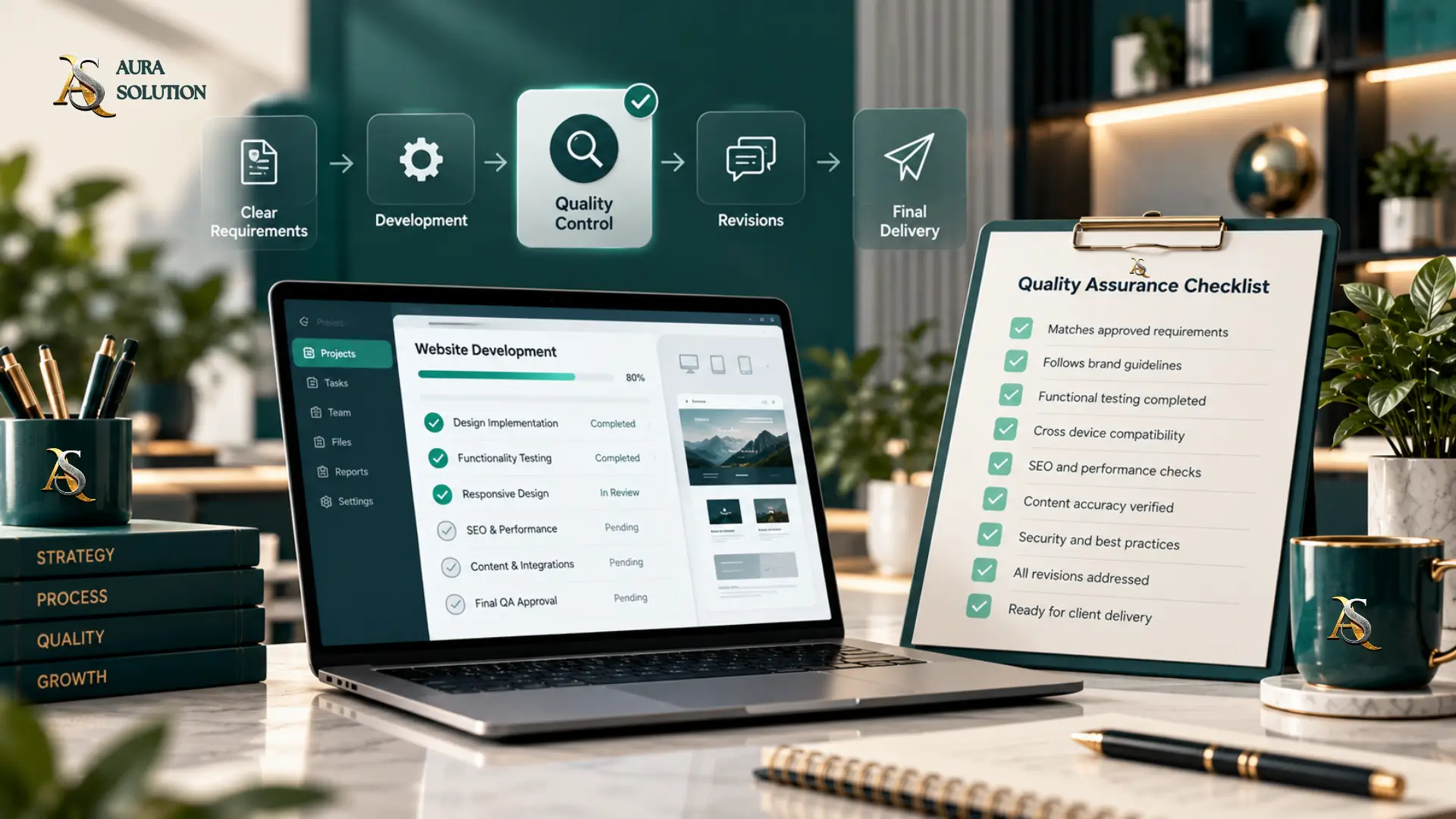
POST BY

aura solution
PUBLISHED
November 12, 2026
CATEGORY
Development
aura solution
Web Developer
Introduction
Outsourcing digital services can help an agency take on more projects, access specialist skills, and expand its service offerings without hiring an entire in house team. However, there is one concern that often prevents agency owners from outsourcing with confidence: quality.
What happens if the website does not match the approved design? What if an SEO deliverable overlooks important technical issues? What if a video editor misses the brand guidelines or a graphic designer delivers files in the wrong format?
For agencies working with US clients, these problems can affect more than an individual project. They can lead to additional revisions, delayed launches, difficult client conversations, reduced profitability, and damage to the agency’s reputation.
The answer is not necessarily to stop outsourcing or inspect every task personally. It is to build a quality control system that makes expectations clear, verifies work against agreed standards, and identifies problems before deliverables reach the client.
Quality control for outsourced projects means systematically checking that external work meets the agreed scope, technical requirements, brand standards, and acceptance criteria before it is approved or delivered.
When agencies combine clear briefs, service specific checklists, accountable reviewers, and constructive feedback, outsourcing becomes easier to manage and more predictable.
What Is Quality Control for Outsourced Projects?
Quality control for outsourced projects is the process of evaluating completed work against predefined requirements before accepting it or presenting it to the client.
In a white label arrangement, the agency may outsource website development, UI/UX design, SEO, local SEO, graphic design, video editing, social media management, or website maintenance. Each service has different quality requirements, so a single generic checklist is rarely sufficient.
For example, website development quality control may involve testing forms, navigation, mobile layouts, and agreed functionality. Graphic design quality control may focus on brand consistency, typography, dimensions, and file formats. SEO quality control may involve checking technical recommendations, implementation accuracy, page metadata, and the completeness of agreed deliverables.
A practical quality control system answers five questions:
- What exactly was requested?
- What standards must the deliverable meet?
- Who checks the work before approval?
- How are defects, corrections, and additional requests handled?
- How is the final result documented and accepted?
These questions establish a common definition of quality for the agency, its fulfillment partner, and the client.
Why Quality Problems Occur When Agencies Outsource Work
Outsourced work does not automatically produce inconsistent results. Quality problems often arise when the process connecting the agency, its client, and the delivery team is incomplete.
1. The brief does not explain the expected outcome
A request such as “create a modern website” is open to interpretation.
The agency may imagine a minimal design with a particular navigation structure, while the developer follows a different interpretation. Both parties may believe they have completed the request correctly, yet the result still fails to meet the agency’s expectations.
How to prevent it: Document the objective, deliverables, reference examples, required functionality, technical constraints, brand guidelines, and acceptance criteria before work begins.
2. Quality standards exist only in someone’s head
An agency owner may know exactly what a good deliverable looks like, but the external team cannot reliably reproduce an expectation that has never been documented.
This is especially challenging when several people review work differently or when a new specialist joins the delivery process.
How to prevent it: Convert subjective expectations into practical standards, examples, reusable templates, and service specific review checklists.
3. Production and review are treated as the same task
A developer who has just completed a complex feature may overlook an issue because attention has been focused on implementation. A designer may notice visual alignment but miss a missing mobile variant.
Completing a task and independently verifying it are different activities.
How to prevent it: Define a separate quality assurance stage with clear completion criteria. Where practical, have someone other than the original creator review critical requirements.
4. Feedback arrives too late or in conflicting versions
When stakeholders submit separate comments across emails, messaging applications, and meetings, the delivery team may receive contradictory instructions or implement outdated feedback.
How to prevent it: Designate one reviewer, consolidate feedback, record approved changes, and maintain a single source of truth for project requirements.
5. Deadlines leave no time for testing
If the entire schedule is allocated to production, quality assurance becomes rushed or disappears altogether.
The agency may discover broken links, missing content, inconsistent branding, or incomplete functionality only after the client reviews the work.
How to prevent it: Include review time in the original project schedule and make quality assurance a required milestone rather than an optional final task.
6. The scope changes without updating expectations
A client might request extra pages, new functionality, additional graphics, or more extensive SEO work after the project has started.
If these changes are not documented, the delivery team may be judged against requirements that were never included in the original agreement.
How to prevent it: Maintain an approved scope, record new requests, and agree on any necessary changes to pricing, resources, and deadlines.
How Can Agencies Maintain Quality When Outsourcing?
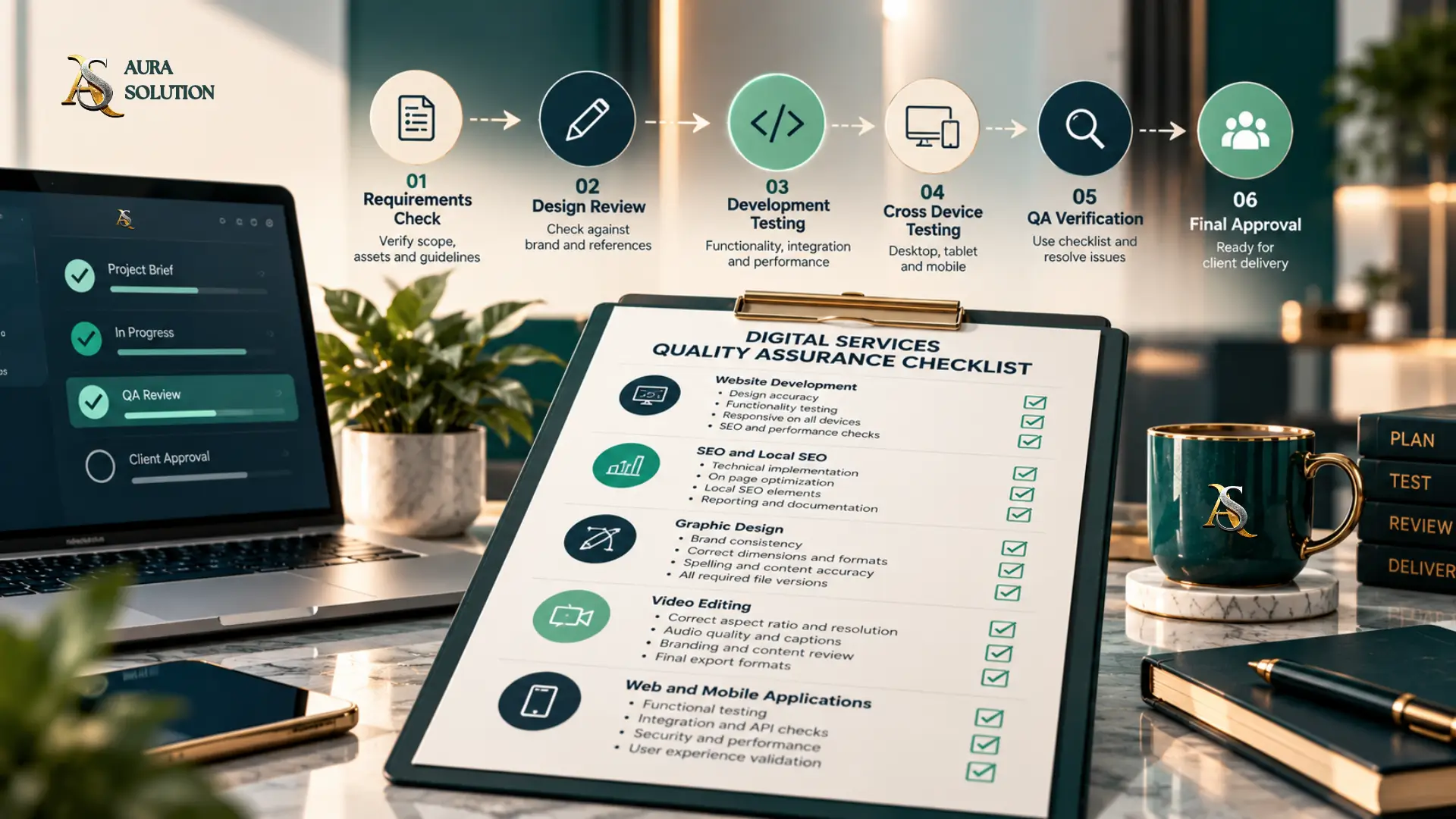
The most reliable approach is to establish quality standards before production, verify work at appropriate stages, and review the results against objective requirements.
Step 1: Define acceptance criteria before assigning the work
Acceptance criteria describe the conditions a deliverable must meet to be considered complete.
For a website development project, the criteria might include:
- All agreed pages are present.
- The design follows the approved layouts and brand guidelines.
- Navigation, forms, and agreed integrations work as specified.
- Responsive layouts are checked at relevant screen sizes.
- Required content, headings, and metadata are present.
- Known issues and outstanding dependencies are documented.
For an SEO engagement, the criteria might include completion of the agreed audit, documented findings, accurate implementation of approved changes, and delivery of the agreed reporting.
Acceptance criteria should be specific enough that two reviewers can evaluate the same deliverable without relying entirely on personal preference.
Step 2: Create service specific quality checklists
Avoid using one checklist for every type of outsourced work.
A website developer, SEO specialist, graphic designer, and video editor produce different deliverables and therefore require different verification procedures.
Create a checklist for each major service category and update it when recurring problems reveal a gap.
For example, a video editing checklist might verify aspect ratio, resolution, audio levels, captions, branding, spelling, and export format. A website checklist might verify responsive behavior, functionality, content, and technical requirements.
The checklist should reflect the contracted scope. It should not introduce new requirements after the work has been completed.
Step 3: Use an appropriate review process
Not every deliverable requires multiple approval layers.
A routine graphic asset may need a brief production check and an agency review. A custom web application may require staged testing, security review, functional validation, and documented acceptance.
Set review depth according to complexity, business impact, technical risk, and client requirements.
The objective is to catch meaningful defects without creating so much administrative overhead that every project slows down unnecessarily.
Step 4: Introduce quality checkpoints throughout production
Quality should be reviewed at appropriate stages rather than only at the end of a project.
For example, a website project may include an initial review of the approved design, a development progress check, a functional testing stage, and a final review before launch.
These checkpoints help identify problems while they are still relatively easy to correct.
For recurring SEO work, quality checks may happen before implementation, after important technical changes, and during monthly reporting.
The right checkpoints depend on the service, project size, and potential consequences of an error.
Step 5: Separate corrections from subjective preferences
A correction addresses a genuine deviation from an agreed requirement. A preference introduces a different choice that may not have been included in the original brief.
Consider a graphic design project.
If the approved brand guidelines specify a particular font and the delivered graphic uses a different font, that is a correction.
If the graphic follows the approved design but the client now prefers a completely different visual direction, the request may represent a new revision or scope change.
This distinction helps agencies avoid endless revision cycles while still taking legitimate quality concerns seriously.
Document the original requirement, the issue identified, and the agreed resolution. This gives both the agency and the fulfillment partner a clear reference point.
Step 6: Create a structured feedback process
Feedback should be specific, actionable, and connected to the original brief.
Instead of writing, “This design does not look right,” explain what needs attention.
For example:
“The mobile navigation overlaps the page heading at the tested viewport. Please correct the spacing and confirm that the navigation remains usable at the required screen sizes.”
A useful feedback process includes:
- A designated reviewer.
- A consolidated list of issues.
- A reference to the relevant requirement or design.
- A priority for each issue.
- An assigned owner and expected resolution date.
- A verification step after the correction.
This makes revisions easier to understand and reduces the likelihood of the same issue returning in later versions.
Step 7: Track defects and recurring patterns
A project management system can record issues identified during quality assurance, their severity, their cause, and how they were resolved.
Useful categories include:
- Missing or misunderstood requirements.
- Visual inconsistencies.
- Functional defects.
- Technical implementation issues.
- Content or formatting errors.
- Delayed approvals or missing client inputs.
- New requests outside the approved scope.
Review these records periodically. If the same issue appears repeatedly, investigate the underlying process rather than correcting each occurrence in isolation.
For example, recurring missing metadata might indicate that the SEO handoff checklist is incomplete. Repeated mobile layout problems might indicate insufficient responsive testing. Frequent misunderstandings might point to unclear briefs.
Step 8: Establish a clear definition of done
A task should not be marked complete merely because production has stopped.
Define completion in terms of the agreed deliverables, required checks, outstanding issues, and documentation.
For a website task, completion might mean the requested functionality has been implemented, the relevant checks have passed, known limitations are recorded, and the work is ready for agency review.
For a monthly SEO task, completion might mean the agreed optimizations have been implemented or documented, relevant verification has been performed, and the required report is ready.
A clear definition of done prevents incomplete work from moving into the next stage simply because a deadline has arrived.
Quality Control Examples Across Different Digital Services
Quality assurance should reflect the actual risks and deliverables of each service. The following examples illustrate how an agency can adapt its process.
Website development and maintenance
Website quality control should verify that the delivered functionality matches the agreed scope and that relevant technical checks have been completed.
A practical review may cover:
- Responsive layouts and navigation.
- Forms, buttons, and agreed integrations.
- Links, content, and visible layout issues.
- Relevant browser and device testing.
- Approved SEO requirements, including headings and metadata where included.
- Backup, deployment, and access procedures where applicable.
Not every website requires the same level of testing. A simple informational website and a complex ecommerce implementation have different technical requirements and risk profiles.
SEO and local SEO
SEO quality control should distinguish between completing an agreed task and achieving a business outcome.
For example, implementing approved title tags, fixing identified crawl issues, or completing an agreed Google Business Profile update can be verified directly. Ranking changes, lead volume, and revenue depend on additional factors and should not be treated as guaranteed outcomes of task completion.
Review the accuracy of recommendations, implementation quality, page targeting, internal linking, reporting, and any relevant technical changes.
Where appropriate, document issues that require client approval or access before implementation.
Graphic design and video editing
Creative work requires both objective checks and judgment about the brief.
For graphic design, verify dimensions, file formats, typography, brand colors, image quality, and required versions.
For video editing, verify aspect ratio, resolution, audio levels, captions, spelling, transitions, branding, and export specifications.
A design can pass technical checks and still need creative refinement. This is why the approved creative direction and examples should be documented before production begins.
Web applications and mobile applications
Application projects may require functional testing, validation of user flows, error handling, compatibility checks, access control review, and security testing appropriate to the project.
Critical functionality should be checked against defined acceptance criteria. Issues should be documented, prioritized, and resolved or formally accepted before release according to the agreed risk and release process.
For projects involving sensitive information or payments, the agency should ensure that appropriate security and compliance requirements are included in the project scope.
How to Measure Outsourced Work Quality
Agencies need metrics that show whether their quality control process is working.
Metric | What it measures | How to use it |
First review acceptance rate | Deliverables accepted without substantive correction | Identify problems with briefs, execution, or standards |
Defect rate | Issues identified relative to an agreed unit of work | Monitor recurring quality problems |
Revision rounds | Number of review and correction cycles | Identify avoidable rework and unclear requirements |
On time delivery rate | Deliverables completed by agreed deadlines | Evaluate delivery reliability |
Rework hours | Time spent correcting work that did not meet requirements | Understand the operational cost of defects |
Client satisfaction | Client feedback on quality and delivery | Identify issues that internal checks may miss |
Define each metric consistently before comparing results. For example, distinguish corrections required to meet the original brief from additional client requests.
Avoid inventing universal targets without considering the service, project complexity, baseline performance, and client expectations. An agency should establish realistic targets from its own delivery data and improve them over time.
How to Maintain Client Trust When Outsourcing Digital Services
Quality control is not only about technical correctness. It also influences how confidently an agency can communicate with its clients.
A client expects the agency to understand the brief, manage the work, explain decisions, and resolve problems. The agency therefore needs a clear process for reviewing outsourced work before presenting it, while remaining transparent about the services and responsibilities covered by its agreements.
Keep the agency accountable for client delivery
Outsourcing production does not remove the agency’s responsibility to manage its client commitments.
The agency should understand what has been delivered, what remains outstanding, whether the work meets the agreed requirements, and what risks need to be communicated.
This does not mean the agency owner must personally inspect every line of code or every creative asset. It means the agency needs appropriate review procedures and clear ownership of the final client handoff.
Agree on communication boundaries
In a white label arrangement, the agency and fulfillment partner should agree on who communicates with the end client, who approves changes, and how sensitive information is handled.
If the provider is expected to work behind the agency’s brand, these expectations should be documented in the partnership agreement and operating process.
Clear boundaries protect the client relationship while ensuring that the delivery team receives the information needed to complete the work.
Communicate problems early
When a technical dependency, missing asset, or unexpected issue threatens a deadline, communicate it before the final delivery date whenever possible.
Explain the issue, its likely impact, the action being taken, and any decision required from the client or agency.
Early communication allows the agency to manage expectations and make informed decisions instead of explaining an avoidable surprise after a deadline has passed.

What Should Agencies Do When an Outsourced Deliverable Fails Quality Checks?
A failed quality check should trigger a documented resolution process, not an argument about responsibility.
Step 1: Identify the specific failure. Record what is incorrect, incomplete, or inconsistent with the approved requirements.
Step 2: Establish the cause. Determine whether the issue resulted from an incomplete brief, a misunderstanding, a production error, an overlooked dependency, or a later scope change.
Step 3: Assign corrective action. Identify who will resolve the issue and agree on a reasonable completion date.
Step 4: Verify the correction. Recheck the deliverable against the original acceptance criteria.
Step 5: Improve the process where necessary. If the problem is recurring, update the brief, checklist, training, or review procedure.
The agency should also distinguish between a genuine delivery defect and a new request. Corrections required to meet the agreed scope should be handled according to the partnership terms, while additional requirements may need a revised estimate or timeline.
How to Choose a White Label Partner With Strong Quality Standards
A provider’s service list and pricing do not tell the whole story. Agencies should evaluate how the provider manages requirements, reviews work, handles corrections, and communicates during delivery.
Ask about the quality assurance process
Ask how deliverables are checked before handoff, whether service specific checklists are used, and how defects are recorded and resolved.
The provider should be able to explain its process clearly without promising that every deliverable will be flawless.
Review relevant work samples
Examine examples that match the type of service you intend to outsource. For website development, assess functionality and responsive behavior as well as visual appearance. For creative work, evaluate adherence to the brief and brand consistency. For SEO, look for clear documentation and technically sound recommendations.
Samples provide useful context, but they should not replace an evaluation of actual delivery performance.
Evaluate communication and revision management
Confirm who will answer questions, how progress is reported, how feedback is consolidated, and how urgent problems are escalated.
Clarify the scope of included revisions and the process for handling additional requirements.
Start with a defined project
Where practical, begin with a manageable assignment that reflects the work you expect to outsource regularly.
Evaluate whether the provider follows the brief, meets agreed deadlines, communicates clearly, responds constructively to feedback, and delivers the required documentation.
A controlled initial engagement helps both parties identify process gaps before the relationship expands.
How Aura Solution Can Help Agencies Maintain Delivery Quality
Aura Solution supports agencies seeking white label digital fulfillment across website development, web applications, mobile applications, UI/UX design, SEO, local SEO, website maintenance, graphic design, video editing, and social media management.
For agencies serving US clients, the right delivery arrangement should align with the agency’s quality standards, client expectations, project scope, and communication requirements.
A practical starting point is to identify which services create the greatest delivery pressure, where recurring corrections occur, and which capabilities your existing team cannot comfortably support.
From there, an agency can establish clear requirements, agree on review procedures, and determine whether external fulfillment is appropriate for particular projects or recurring workloads.
If your agency is looking for a white label partner, explore Aura Solution’s digital services and discuss the delivery requirements that matter to your team.
The goal is not simply to outsource more work. It is to deliver work your agency can confidently stand behind.
Frequently Asked Questions
How can digital agencies maintain quality when outsourcing client work?
Digital agencies can maintain quality by documenting requirements, defining acceptance criteria, using service specific checklists, reviewing deliverables before client handoff, and tracking recurring defects. Clear communication and an agreed process for corrections are also essential.
What is quality control for outsourced projects?
Quality control for outsourced projects is the process of checking external deliverables against agreed requirements, technical standards, and acceptance criteria before approval. It helps agencies identify defects, verify completion, and maintain consistent delivery standards.
What should be included in an outsourced project quality checklist?
A quality checklist should reflect the service being delivered. It may include scope compliance, functionality, technical accuracy, brand consistency, formatting, required documentation, testing results, and confirmation that agreed deliverables are complete.
How can agencies reduce revisions when outsourcing digital services?
Agencies can reduce avoidable revisions by providing complete briefs, approving references before production, documenting acceptance criteria, consolidating feedback, and distinguishing corrections from new requests. Reviewing recurring revision patterns can reveal where the process needs improvement.
Who is responsible for quality in a white label partnership?
Responsibilities depend on the agreement. The fulfillment partner is generally responsible for completing its assigned work according to the agreed requirements, while the agency manages its client commitments and the agreed approval process. Both parties should define responsibilities, review stages, and escalation procedures in advance.
How should agencies handle poor quality work from an outsourcing partner?
Document the specific defect, compare it with the approved requirements, establish the cause, assign corrective action, and verify the revised deliverable. Recurring issues should prompt a review of the briefing, production, and quality assurance process.
What is the difference between quality assurance and quality control?
Quality assurance focuses on the processes designed to prevent defects, such as standardized briefs, training, documented procedures, and workflow improvements. Quality control focuses on inspecting deliverables to identify whether they meet the required standards. Both contribute to reliable delivery.
Can outsourcing improve an agency’s service quality?
Outsourcing can improve service quality when the provider offers relevant expertise and follows a suitable delivery process. However, results depend on the provider’s capabilities, the clarity of requirements, the review system, and the quality of collaboration. Outsourcing alone does not guarantee better outcomes.
Conclusion
Maintaining quality when outsourcing client work requires a deliberate system rather than reliance on individual judgment.
Agencies need clear requirements, service specific acceptance criteria, appropriate quality checkpoints, structured feedback, and a process for resolving defects. They should also measure recurring problems and improve the workflow when the same issues appear repeatedly.
These practices help agencies manage external delivery without turning the agency owner into the reviewer of every production detail.
The right white label partner can provide specialist capabilities and additional capacity, but sustainable results depend on a shared understanding of quality and accountability.
For agencies looking to expand their services, the objective should be to build a delivery model that protects client trust while giving the business room to grow. Aura Solution can be a potential white label fulfillment partner for agencies seeking support across multiple digital services.
Explore More
Blogs

Why Every Business Needs a Mobile-Friendly Website in 2025
As smartphone usage continues to dominate web traffic, businesses that neglect their mobile presence r
Aura Solution
June 15. 2025

How to Choose the Right Digital Marketing Partner in the USA
Choosing a digital marketing agency is a major decision for any business. With so many options, how do you find ....
Aura Solution
31 May 2025

Top Digital Marketing Strategies That Drive Results for US Businesses in 2025
As we move through 2025, digital marketing continues to evolve at a rapid pace. With increased competition
Aura Solution
15 May 2025