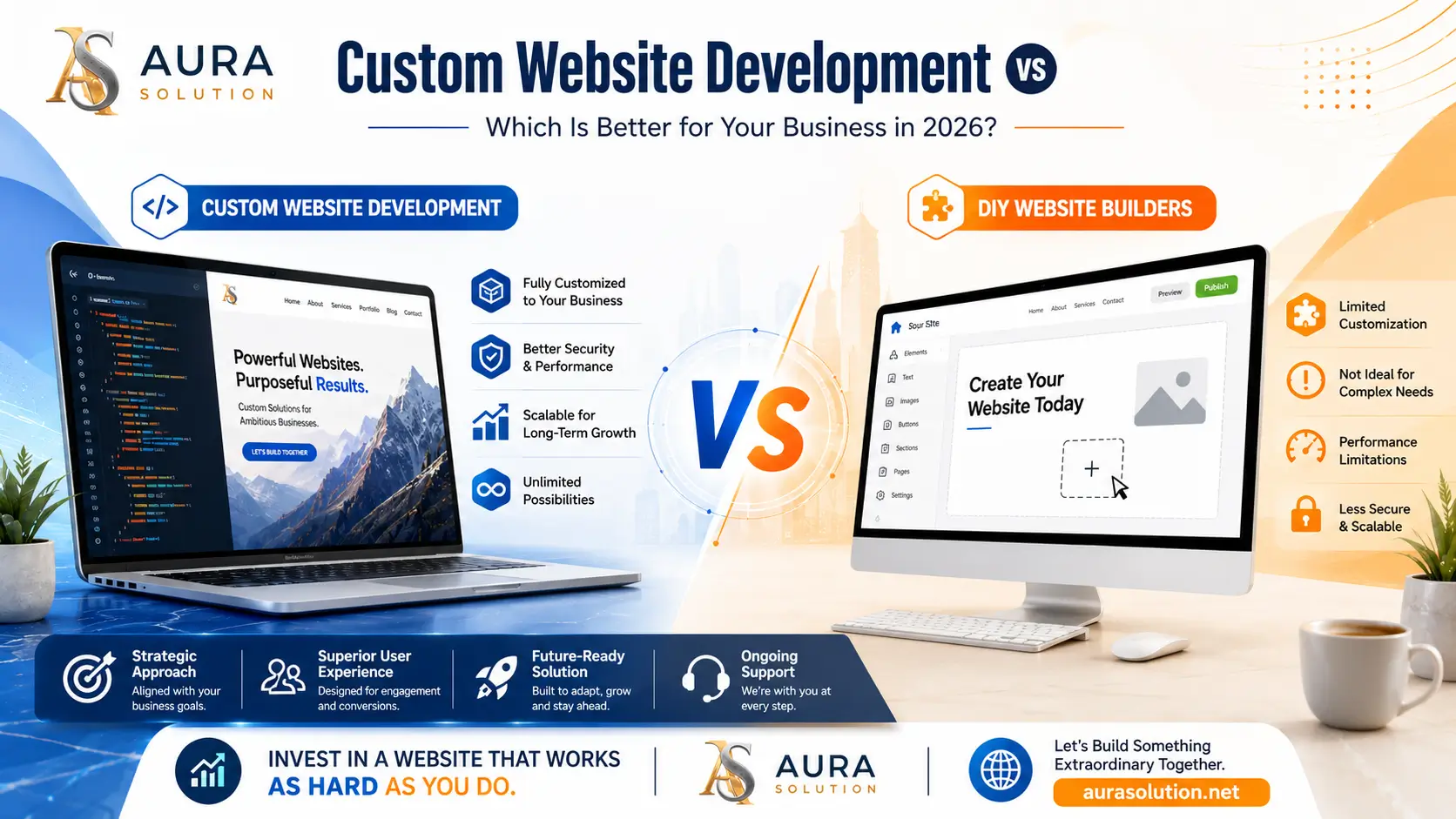
Custom Website Development vs DIY Website Builders: Which Is Better for Your Business in 2026?
POST BY

aura solution
PUBLISHED
july 21, 2026
CATEGORY
Development
aura solution
Web Developer
Introduction
Building a website has never been easier. Platforms such as Wix, Squarespace, Shopify, and other website builders allow businesses to launch a website quickly without technical knowledge.
While these tools have made website creation more accessible, many growing businesses eventually face an important question: should they continue using a DIY website builder or invest in custom website development?
The answer depends on your business goals, growth plans, budget, and long term digital strategy.
For startups and small businesses, DIY website builders may provide a quick and affordable way to establish an online presence. However, as businesses grow and require more functionality, customization, and performance, the limitations of these platforms often become apparent.
This guide compares custom website development and DIY website builders to help businesses determine which option provides the best value and long term results.
Understanding DIY Website Builders
DIY website builders are platforms designed to help users create websites without coding knowledge.
Popular examples include:
Wix
Squarespace
Shopify
Weebly
Webflow
These platforms provide templates, drag and drop editors, and built in features that simplify website creation.
For many businesses, this makes launching a website fast and convenient.
Benefits of DIY Website Builders
Lower Initial Cost
One of the biggest advantages of DIY website builders is affordability.
Most platforms offer monthly subscription plans that are significantly cheaper than custom development.
This makes them attractive to startups and small businesses with limited budgets.
Faster Launch Time
DIY platforms allow businesses to launch websites quickly.
Many websites can be built and published within days rather than weeks or months.
For businesses needing a simple online presence, speed can be a significant advantage.
Easy Content Management
Most website builders are designed for non technical users.
Updating text, images, and pages is often straightforward.
This reduces the need for ongoing technical support.
Built In Features
Website builders typically include:
Hosting
Security certificates
Templates
Basic SEO tools
Analytics integrations
This simplifies website management for small businesses.
Limitations of DIY Website Builders
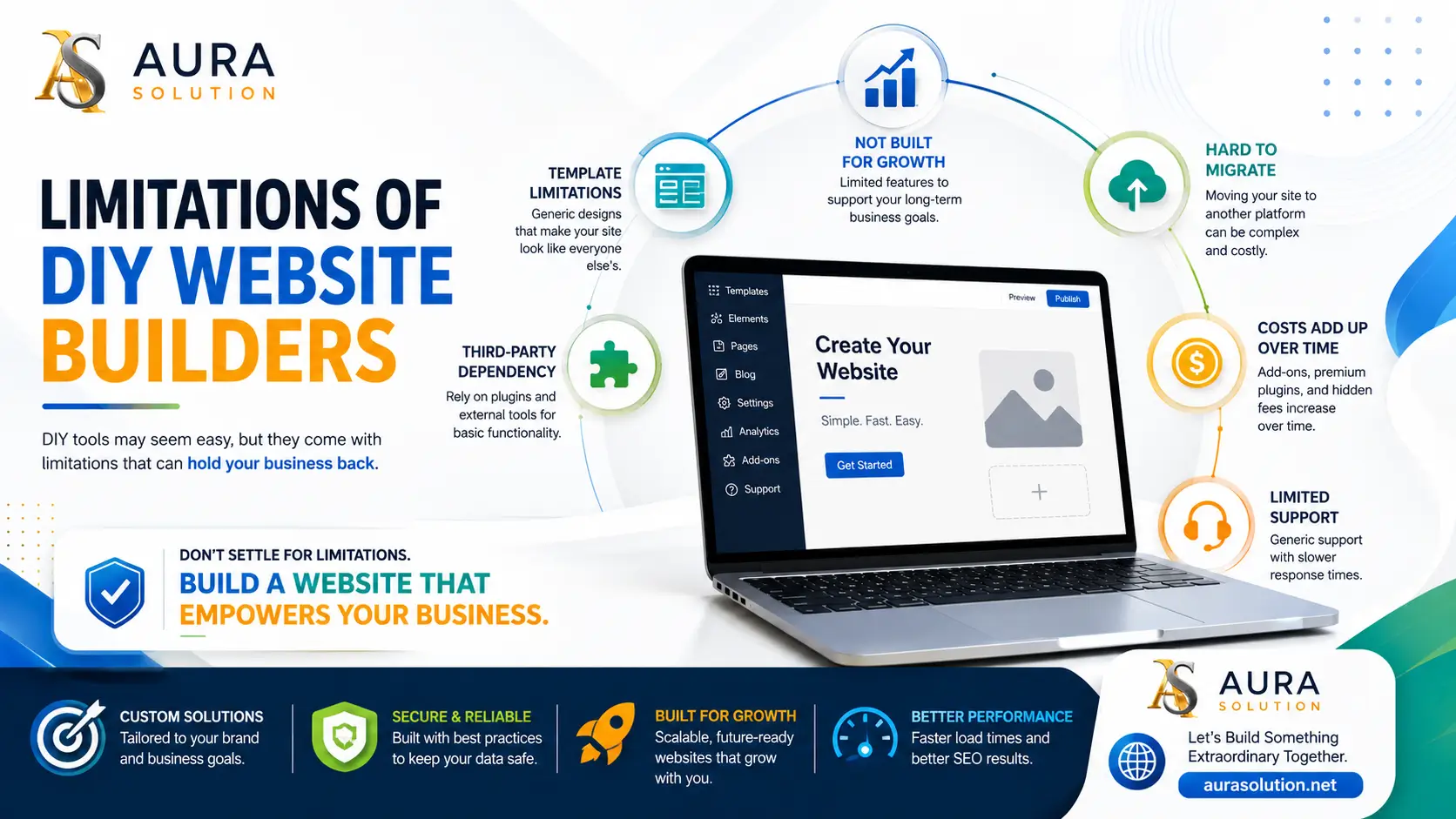
While website builders offer convenience, they also come with limitations.
Limited Customization
Templates often restrict design flexibility.
Businesses may struggle to create unique user experiences that differentiate them from competitors.
As more companies use the same templates, websites can begin to look similar.
Scalability Challenges
As businesses grow, they often require:
Custom integrations
Advanced functionality
Complex workflows
Unique user experiences
Many DIY platforms struggle to support these requirements efficiently.
Performance Limitations
Website speed and performance can be affected by platform restrictions.
Businesses focused on SEO and conversion optimization may find these limitations frustrating.
Dependence on Platform Features
Businesses using DIY builders are limited by the platform’s available features and development roadmap.
If a desired feature does not exist, implementation may be difficult or impossible.
What Is Custom Website Development?
Custom website development involves designing and building a website specifically for the needs of a business.
Unlike template based websites, custom websites are created from the ground up.
Every aspect of the website can be tailored to support business goals, branding, functionality, and user experience.
Custom development provides flexibility and control that website builders often cannot match.
Benefits of Custom Website Development
Unique Branding
A custom website reflects your business identity rather than relying on a pre designed template.
This helps businesses stand out in competitive markets.
A distinctive online presence strengthens brand recognition and credibility.
Better User Experience
Custom websites are designed around user behavior and business objectives.
This allows businesses to create optimized customer journeys that improve engagement and conversions.
A better user experience often translates into more leads and sales.
Greater Scalability
As businesses grow, custom websites can evolve with them.
New functionality can be added without being constrained by platform limitations.
Examples include:
Customer portals
Membership systems
Booking platforms
Advanced ecommerce features
Custom integrations
Scalability is one of the biggest advantages of custom development.
Improved SEO Opportunities
Search engine optimization often benefits from custom development.
Businesses can implement:
Custom site structures
Advanced technical SEO
Optimized performance
Schema markup
Custom landing pages
This creates a stronger foundation for organic growth.
Higher Performance
Custom websites can be optimized specifically for speed, security, and functionality.
This often results in better performance compared to template based alternatives.
Faster websites improve user experience and search engine rankings.
Comparing Costs
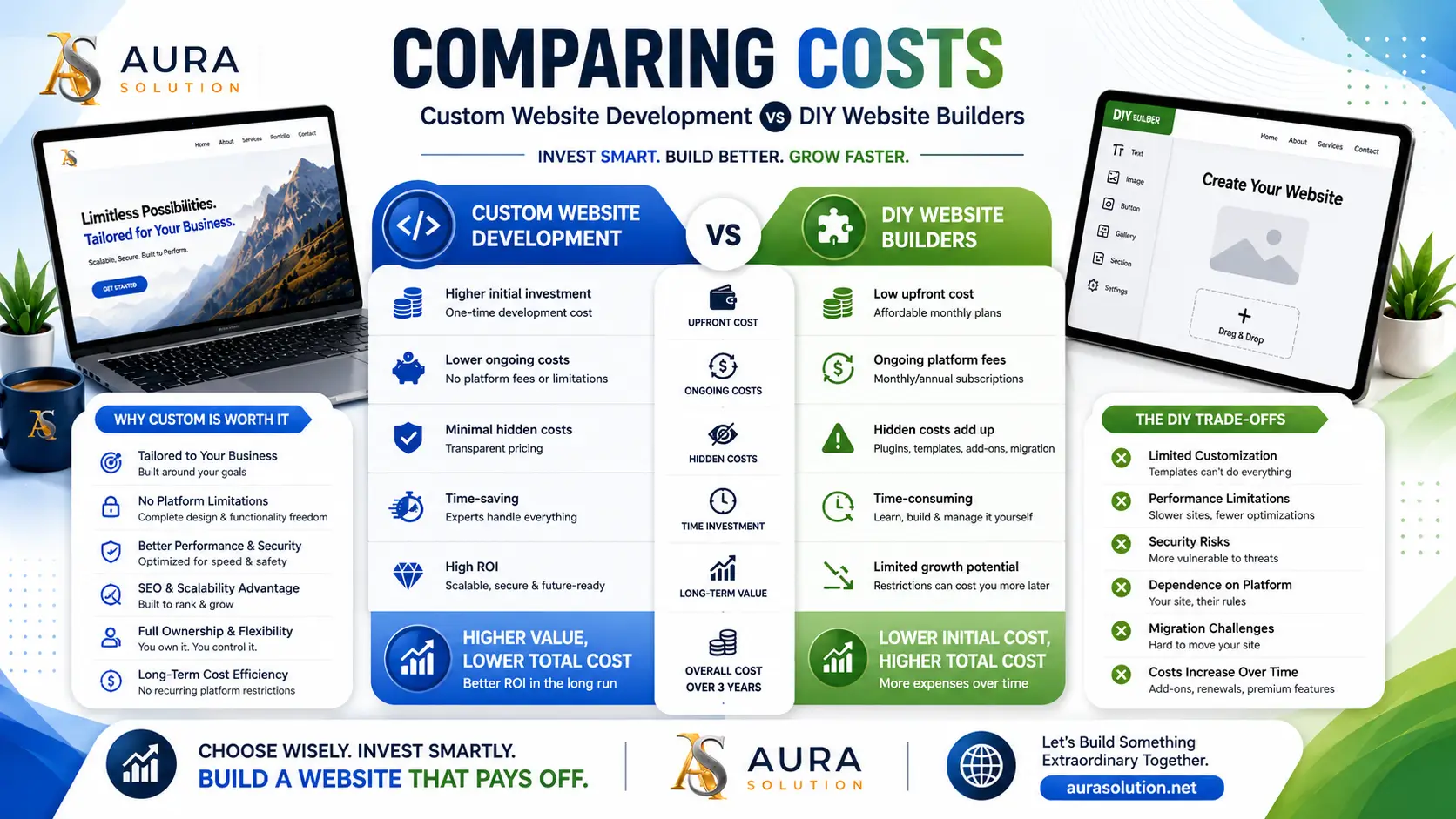
Cost is often one of the biggest factors when choosing between DIY builders and custom development.
DIY Website Builders
Monthly subscriptions typically range from:
$15 to $300+ per month
Depending on features and functionality.
Custom Website Development
Professional custom websites typically range from:
$2,500 to $50,000+
Depending on project complexity.
While the initial investment is higher, businesses often receive greater long term value.
Comparing SEO Potential
SEO is a critical consideration for businesses seeking online visibility.
DIY Platforms
Most website builders provide basic SEO functionality.
However, customization options can be limited.
Custom Websites
Custom development provides greater control over:
Technical SEO
Site architecture
Performance optimization
User experience
Advanced SEO strategies
Businesses focused on organic growth often benefit from the flexibility of custom solutions.
Comparing Long Term Value
DIY builders can be excellent starting points for small projects.
However, businesses planning significant growth often encounter limitations.
Custom websites offer:
Long term scalability
Greater flexibility
Improved performance
Stronger branding
Enhanced lead generation
When evaluated over several years, custom development frequently provides better return on investment.
Which Option Is Best for Small Businesses?
The answer depends on business goals.
A DIY website builder may be appropriate when:
The budget is limited
The website is simple
Advanced functionality is not required
The business needs a quick launch
Custom website development is often the better choice when:
Growth is a priority
SEO is important
Unique branding is required
Advanced functionality is needed
Lead generation is a major objective
Businesses should evaluate both current needs and future goals before making a decision.
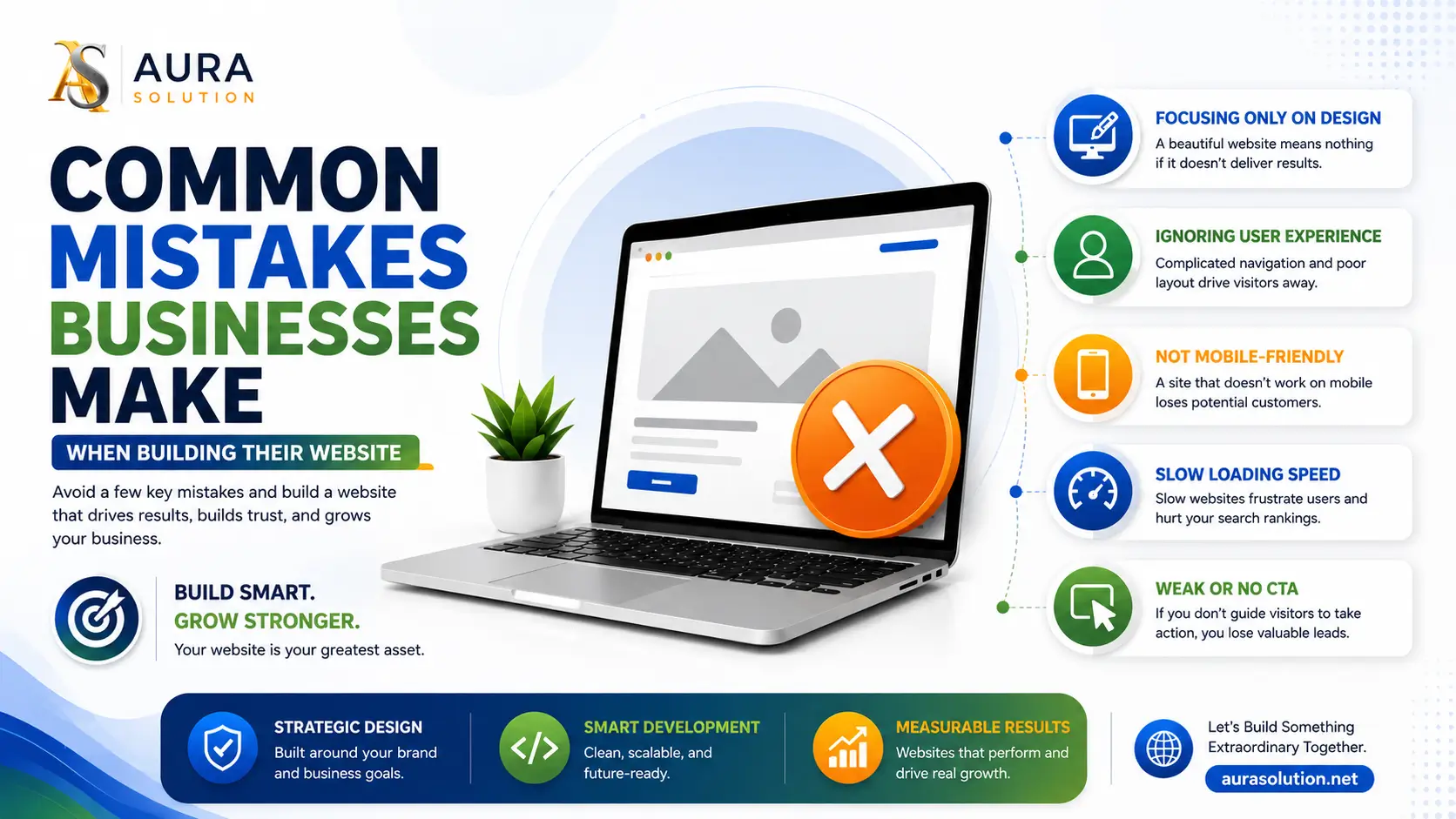
Common Mistakes Businesses Make
Choosing Based Only on Price
The cheapest option is not always the most cost effective in the long term.
Businesses should evaluate value rather than focusing solely on upfront costs.
Ignoring Scalability
Many businesses outgrow their websites and require costly redesigns.
Planning for future growth helps avoid unnecessary expenses.
Overlooking SEO
A website should support long term visibility and marketing objectives.
SEO considerations should be part of the decision making process.
Why Many Businesses Transition to Custom Development
As businesses grow, they often require:
More leads
Better performance
Stronger branding
Greater flexibility
Advanced functionality
This is why many companies eventually move from DIY platforms to custom website solutions.
The transition often supports stronger growth and better digital performance.
How Professional Website Development Supports Business Growth
A professionally developed website becomes more than an online presence.
It becomes a business asset that supports:
Lead generation
Customer acquisition
Brand positioning
Marketing campaigns
Revenue growth
Businesses across the United States often partner with Aura Solution to create custom websites designed around their goals, audience, and long term growth strategies.
Final Thoughts
Both DIY website builders and custom website development have their place.
DIY platforms offer affordability and convenience, making them suitable for simple websites and startups.
Custom website development provides flexibility, scalability, performance, and long term value for businesses focused on growth.
The right choice depends on your objectives, budget, and future plans.
For businesses looking to build a strong online presence and generate consistent results, investing in a custom website often becomes one of the most valuable decisions they can make.
FAQs
Is custom website development worth the investment?
Yes. Custom websites provide greater flexibility, scalability, branding opportunities, and long term value.
Are DIY website builders good for SEO?
They provide basic SEO capabilities, but custom websites generally offer greater optimization opportunities.
Which option is better for lead generation?
Custom websites are typically better for lead generation because they can be designed specifically around conversion goals.
When should a business move from a DIY platform to a custom website?
Businesses should consider custom development when they need more functionality, stronger branding, better SEO, or improved scalability.
Explore More
Blogs

Why Every Business Needs a Mobile-Friendly Website in 2025
As smartphone usage continues to dominate web traffic, businesses that neglect their mobile presence r
Aura Solution
June 15. 2025

How to Choose the Right Digital Marketing Partner in the USA
Choosing a digital marketing agency is a major decision for any business. With so many options, how do you find ....
Aura Solution
31 May 2025

Top Digital Marketing Strategies That Drive Results for US Businesses in 2025
As we move through 2025, digital marketing continues to evolve at a rapid pace. With increased competition
Aura Solution
15 May 2025