

POST BY

aura solution
PUBLISHED
October 29, 2026
CATEGORY
Development
aura solution
Web Developer
Introduction
White label services can help digital agencies expand their service offerings, increase delivery capacity, and take on more clients without building every capability internally.
But there is another question every agency owner needs to answer:
How much should you charge your client for a white label service?
Choosing a white label provider is only one part of the process.
Your agency also needs a pricing model that covers fulfillment costs, client management, revisions, software, overhead, and other business expenses while leaving enough margin to support sustainable growth.
For US digital agencies, the difference between a simple markup and a carefully planned pricing strategy can have a significant impact on profitability.
A service that generates revenue but consumes too much management time may not be as profitable as it appears.
This guide explains how agencies can price white label services, calculate margins, structure recurring packages, manage fulfillment costs, and build a pricing model that supports long term growth.
What Is White Label Pricing?
White label pricing is the cost an agency pays a third party to fulfill a service that the agency sells to its own client under its brand.
For example:
An agency may sell monthly SEO to a client for $2,000 per month.
The agency’s white label fulfillment cost might be $900 per month.
The agency then manages the client relationship, strategy, reporting, communication, and other operating responsibilities.
The difference between client revenue and direct fulfillment costs contributes toward the agency’s gross profit.
The actual profit is affected by additional costs such as account management, sales, software, taxes, administration, and overhead.
This is why agencies should look beyond simple markup when setting prices.
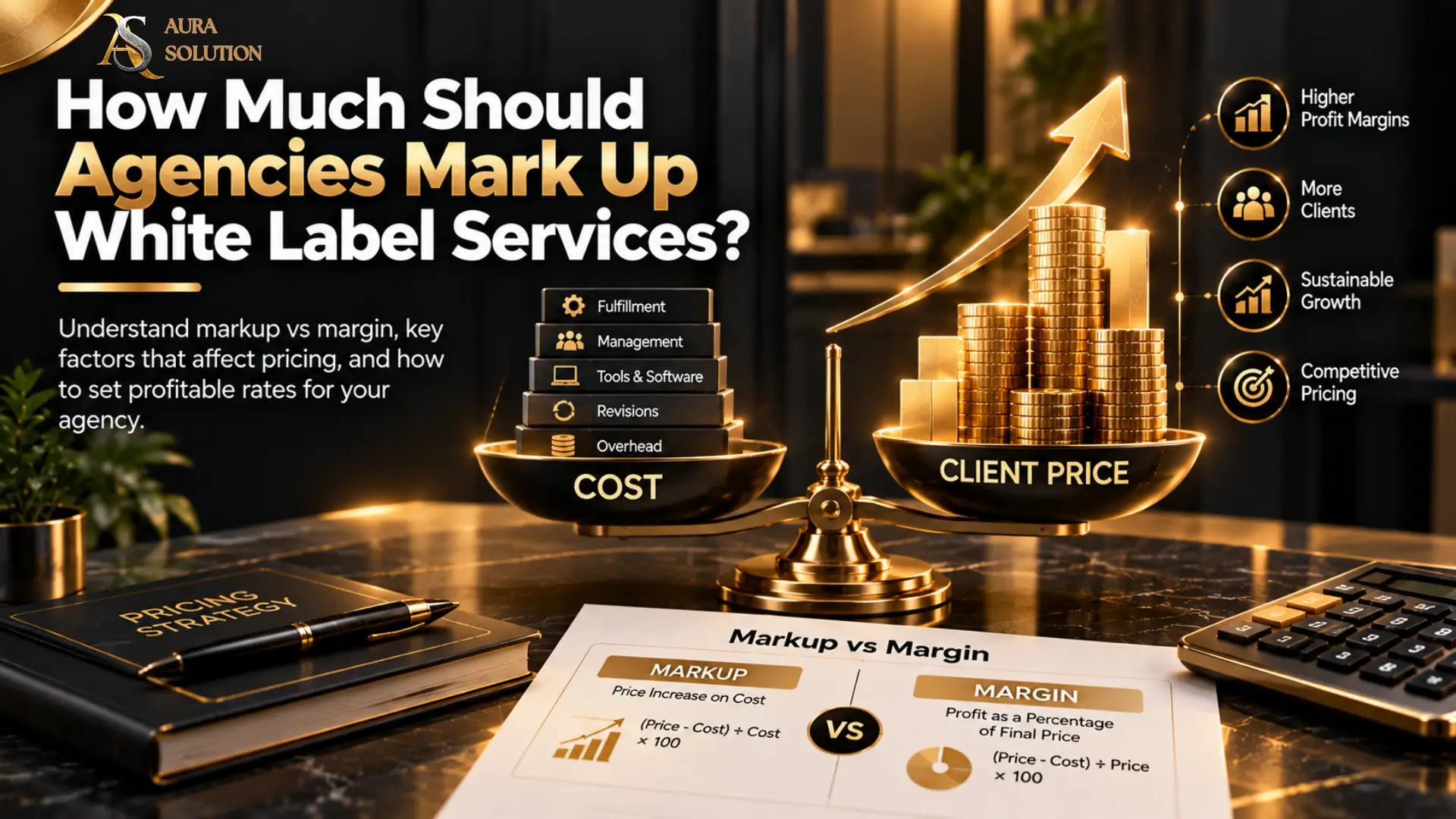
Markup vs Margin: What Is the Difference?
Markup and margin are not the same thing.
Suppose your white label fulfillment cost is:
$1,000
And you charge your client:
$2,000
Your markup is:
100%
But your gross margin is:
50%
The calculation is:
Gross Margin = (Client Price − Fulfillment Cost) ÷ Client Price × 100
In this example:
($2,000 − $1,000) ÷ $2,000 × 100 = 50%
Understanding this difference is important when building profitable agency pricing.
What Costs Should Agencies Consider Before Setting Prices?
White label fulfillment is only one part of your total delivery cost.
Before pricing a service, consider:
- White label fulfillment
• Account management
• Project management
• Sales commissions
• Software
• Reporting
• Communication
• Quality assurance
• Revisions
• Payment processing
• Administrative costs
• Taxes
• General overhead
For example, if you pay a white label partner $800 for a service but spend another $250 managing the account and $100 on direct software and reporting costs, your actual direct delivery cost is closer to:
$1,150
Not $800.
Your client pricing should therefore be based on the total economics of delivering the service.
How Should Agencies Calculate White Label Service Pricing?
A simple starting formula is:
Client Price = Total Direct Delivery Cost + Desired Gross Profit
For example:
Cost | Amount |
White Label Fulfillment | $800 |
Account Management | $200 |
Software and Reporting | $100 |
Total Direct Cost | $1,100 |
Client Price | $2,200 |
Gross Profit | $1,100 |
Gross Margin | 50% |
This is only an illustrative example.
Actual agency pricing should reflect the service, market, client requirements, positioning, scope, and operating costs.
How Much Should Agencies Mark Up White Label Services?
There is no universal markup that works for every agency or service.
The appropriate price depends on:
- Service complexity
• Fulfillment cost
• Client expectations
• Agency positioning
• Account management requirements
• Revision requirements
• Reporting requirements
• Market conditions
• Competition
• Desired margin
• Client lifetime value
Instead of asking:
“What markup should I use?”
Ask:
“What client price allows this service to be profitable after all relevant costs?”
That is a more useful question for long term agency planning.
How Should Agencies Price White Label SEO Services?
SEO is often well suited to recurring pricing because optimization is generally an ongoing process.
A monthly SEO package may include:
- Technical SEO
• Keyword research
• On page optimization
• Content optimization
• Local SEO
• Internal linking
• Citation management
• Competitor research
• Reporting
• Performance monitoring
Suppose the total direct fulfillment and management cost of an SEO package is $750 per month.
The agency could build a client package around its desired margin and scope.
For example:
Item | Example |
Fulfillment | $550 |
Account Management | $150 |
Reporting and Tools | $50 |
Total Direct Cost | $750 |
Client Price | $1,500 |
Gross Profit | $750 |
Gross Margin | 50% |
The actual pricing should depend on the scope and market rather than copying another agency’s price.
How Should Agencies Price White Label Web Development?
Website development is different from recurring SEO because projects often involve significant one time production.
The agency should calculate:
- Design requirements
• Development hours
• Functionality
• Integrations
• Ecommerce requirements
• Content implementation
• QA
• Project management
• Revisions
• Launch support
• Post launch support
For example:
White Label Development Cost: $2,000
Agency Project Management: $500
QA and Testing: $250
Other Direct Costs: $250
Total Direct Cost: $3,000
If the agency charges the client $6,000:
Gross Profit = $3,000
Gross Margin = 50%
Again, these numbers are examples rather than recommended market prices.
How Should Agencies Price Website Maintenance?
Website maintenance can be particularly useful for creating recurring revenue after a website project.
A maintenance package could include:
- WordPress updates
• Plugin updates
• Security monitoring
• Backups
• Technical troubleshooting
• Minor content updates
• Form testing
• Performance monitoring
Agencies can structure packages around different service levels.
Basic Maintenance
Suitable for clients that need routine technical maintenance.
Growth Maintenance
Includes maintenance plus a defined number of content or website updates.
Premium Support
Includes higher priority technical assistance, development support, and additional monthly hours.
The important factor is clearly defining what each package includes.

How Should Agencies Price White Label Design Services?
Design services can vary significantly depending on complexity.
A white label design project might include:
- Website UI UX design
• Landing page design
• Social media graphics
• Advertising creatives
• Presentation design
• Branding assets
• Marketing materials
Agencies should consider whether pricing is:
Per project
Per design
Per hour
Per monthly package
Per retainer
For recurring design services, a monthly package can make revenue and workload easier to forecast.
How Should Agencies Price White Label Video Editing?
Video editing can also be packaged in several ways.
An agency might charge based on:
- Number of videos
• Video length
• Editing complexity
• Short form content volume
• Long form content volume
• Motion graphics
• Captions
• Revisions
For example, instead of selling individual videos, an agency could create a monthly creative package that includes a defined number of videos and revisions.
This can make the service easier to sell as a recurring retainer.
How Should Agencies Price White Label Mobile App Development?
Mobile app development usually requires a more detailed project estimate.
Consider:
- Number of screens
• Platforms
• UI UX design
• Backend development
• APIs
• Authentication
• Payment functionality
• Push notifications
• Database requirements
• Testing
• App store submission
• Ongoing maintenance
Because mobile app projects can vary substantially in complexity, agencies should avoid using a generic per app price without understanding the technical requirements.
How Can Agencies Create Profitable White Label Packages?
Instead of selling every service separately, agencies can create packages around specific client objectives.
Website Growth Package
Could include:
- Website maintenance
• Landing pages
• Technical SEO
• Conversion improvements
Local Growth Package
Could include:
- Local SEO
• Website optimization
• Content
• Local landing pages
• Monthly reporting
Creative Growth Package
Could include:
- Social media graphics
• Advertising creatives
• Video editing
• Website graphics
Digital Support Package
Could include:
- Website maintenance
• Development hours
• Technical support
• Landing page updates
• Minor design updates
The exact services should depend on the client’s requirements.
Why Recurring Packages Can Improve Agency Profitability
Recurring services can provide more predictable revenue than relying entirely on one time projects.
For example, an agency with:
20 clients × $1,500 monthly
would generate:
$30,000 monthly recurring revenue
before fulfillment costs and other expenses.
If the agency’s average direct delivery cost were $750 per client:
20 × $750 = $15,000 direct monthly delivery cost
Leaving:
$15,000 gross profit
before other operating expenses.
The example demonstrates the economics of recurring revenue. Actual results depend on client retention, service scope, fulfillment costs, staffing, sales costs, overhead, and other factors.
How Can Agencies Protect Their Profit Margins?
Pricing correctly is only the beginning.
Agencies also need to control the scope of work.
Define Deliverables
Specify exactly what the client receives every month.
Define Revision Limits
Unlimited revisions can quickly reduce profitability.
Separate Strategy From Production
Determine which work requires senior agency involvement and which tasks can be fulfilled through standardized processes.
Track Time
Monitor how much account management and communication each client requires.
Review Profitability Regularly
A client that was profitable six months ago may become less profitable if its requirements expand.
Control Scope Creep
Additional work should be identified and priced appropriately.

What Is Scope Creep and Why Does It Affect White Label Profitability?
Scope creep occurs when work gradually expands beyond the original agreement without a corresponding increase in price.
For example, a website maintenance package might originally include:
5 hours of development per month
The client may gradually begin requesting:
- New landing pages
• New functionality
• Ecommerce changes
• Design revisions
• Custom integrations
If the agency continues delivering these requests without adjusting pricing, the actual margin can fall.
A clear scope protects the agency.
How Can Agencies Handle Additional Work?
When a client requests work outside the agreed scope, the agency can classify it as:
Included
Additional billable work
New project
Upgrade
For example:
A client paying for basic maintenance may request a complete new landing page.
Rather than treating it as a routine maintenance request, the agency can quote the landing page separately.
This protects both the client relationship and the agency’s profitability.
How Does White Label Pricing Affect Client Retention?
Pricing should not be considered separately from perceived value.
A client may stay with an agency because of:
- Quality
• Communication
• Results
• Reliability
• Strategic guidance
• Responsiveness
• Convenience
If an agency competes only on price, it may attract clients who are highly price sensitive.
Instead, agencies can position recurring packages around business outcomes and clearly communicate what the client receives.
Should Agencies Show Clients Their White Label Fulfillment Cost?
Generally, an agency’s internal fulfillment cost is part of its business economics.
If the service is being sold under the agency’s brand, the client typically evaluates the agency’s overall service, strategy, delivery, and value rather than the agency’s underlying supplier cost.
However, pricing transparency should still be maintained around:
- Deliverables
• Scope
• Timelines
• Additional costs
• Contract terms
The agency should also ensure that its agreements and partner arrangements properly address confidentiality and commercial terms.
How Can Agencies Increase Margins Without Raising Prices?
Increasing profitability does not always require charging clients more.
Agencies can improve margins by improving delivery efficiency.
For example:
Standardize Processes
Create repeatable workflows for recurring services.
Use Templates
Templates can reduce repetitive production work.
Improve Client Onboarding
Better requirements at the beginning can reduce revisions later.
Consolidate Feedback
Collecting client feedback in one structured process can reduce communication time.
Improve QA
Catching issues before client review reduces rework.
Use the Right Fulfillment Model
A specialized white label partner may reduce the cost and complexity of building every capability internally.
When Should Agencies Raise Their Prices?
Agencies may need to review pricing when:
- Fulfillment costs increase
• Scope increases
• Client expectations increase
• Additional services are added
• Account management requirements increase
• The agency’s positioning changes
• Demand increases
• The current margin is no longer sustainable
Price reviews should be based on business economics and value rather than arbitrary increases.
How Can Agencies Build a White Label Pricing Calculator?
A simple internal pricing calculator can include:
Input | Example |
White Label Fulfillment | $600 |
Account Management | $150 |
Software | $50 |
QA | $50 |
Other Direct Costs | $50 |
Total Direct Cost | $900 |
Desired Gross Margin | 50% |
Required Client Price | $1,800 |
The formula for calculating a target client price based on a desired gross margin is:
Client Price = Total Direct Cost ÷ (1 − Desired Gross Margin)
For a $900 direct cost and a 50% desired gross margin:
$900 ÷ (1 − 0.50) = $1,800
This provides a starting point for pricing discussions.
The agency can then consider market positioning, client value, competition, scope, and strategic considerations before finalizing the price.
How Should Agencies Compare White Label Providers?
The cheapest provider is not necessarily the most profitable.
Consider the full cost of fulfillment.
Factor | Provider A | Provider B |
Fulfillment Cost | Lower | Higher |
QA | Limited | Structured |
Communication | Basic | Dedicated |
Revisions | More frequent | Controlled |
Project Management | Limited | Structured |
Turnaround | Variable | Defined |
Support | Limited | Ongoing |
Rework | Potentially higher | Potentially lower |
A provider with a higher initial cost could potentially produce a better overall business outcome if it reduces rework, management time, delays, and client issues.
The agency should therefore evaluate total delivery economics, not simply the supplier’s quoted price.
What White Label Services Can Create Recurring Revenue?
Agencies can consider recurring packages around:
- SEO
• Local SEO
• Website maintenance
• Website management
• Development support
• Landing page development
• Graphic design
• Video editing
• Content services
• Technical support
• Digital marketing
• Ecommerce support
The best recurring service is one that solves an ongoing client need while remaining operationally sustainable for the agency.
How Can a White Label Partner Help Improve Agency Profitability?
A white label partner can potentially help an agency improve its economics by providing access to specialized fulfillment without requiring the agency to immediately build every capability internally.
For example, an agency may avoid adding multiple full time roles until demand justifies those positions.
The agency can instead use external fulfillment capacity for selected services or overflow work.
This can provide flexibility while the agency builds its client base.
However, outsourcing does not automatically create higher margins.
The agency still needs to:
- Price correctly
• Manage scope
• Control revisions
• Monitor fulfillment costs
• Track account management time
• Maintain quality
• Retain clients
Frequently Asked Questions
How should agencies price white label services?
Agencies should calculate their total direct delivery costs, determine the desired gross margin, evaluate market positioning and client value, and then establish pricing that supports sustainable profitability.
How much should an agency charge for white label services?
There is no universal price. The appropriate price depends on fulfillment costs, service scope, client expectations, agency positioning, management requirements, and desired margin.
What is a good profit margin for white label services?
There is no single margin that applies to every agency or service. Agencies should calculate their own direct costs, overhead, desired profitability, and pricing position before setting a target.
What is the difference between markup and margin?
Markup measures how much the price is increased above cost. Margin measures the percentage of the final selling price that remains after the direct cost is deducted.
Should agencies mark up white label services?
An agency generally needs to price above its fulfillment cost because it also provides client management, strategy, communication, quality control, sales, and other business functions.
How should agencies price white label SEO?
SEO can be priced as a monthly recurring service based on the scope of optimization, content, technical work, reporting, local SEO, competition, fulfillment costs, and desired margin.
How should agencies price white label web development?
Website development pricing should account for design, development, functionality, integrations, ecommerce requirements, project management, QA, revisions, launch, and post launch support.
How can agencies protect their white label profit margins?
Agencies can protect margins by defining scope, controlling revisions, tracking fulfillment and management costs, standardizing processes, monitoring client profitability, and pricing additional work appropriately.
Can white label services create recurring revenue?
Yes. Services such as SEO, website maintenance, development support, creative services, content, and technical support can be structured as recurring monthly services when clients have ongoing needs.
Should agencies choose the cheapest white label provider?
Price should be evaluated alongside quality, communication, reliability, turnaround, QA, security, and rework. A lower fulfillment cost does not necessarily result in a higher overall profit.
How can a digital agency increase profit without increasing prices?
Agencies can improve profitability by reducing rework, standardizing fulfillment, improving onboarding, controlling scope, reducing unnecessary management time, and improving operational efficiency.
Final Thoughts
White label services can give digital agencies a flexible way to expand their capabilities without building every fulfillment function internally.
But outsourcing alone does not create profitability.
The agency needs a pricing strategy that accounts for the complete cost of delivering the service.
That means understanding:
Fulfillment cost
Account management
Software
QA
Revisions
Project management
Overhead
Client value
Desired margin
The objective is not simply to add a markup to a supplier’s price.
The objective is to create a service model where the agency can deliver strong client value while maintaining a sustainable margin.
For US digital agencies, this can make white label services more than an outsourcing strategy.
They can become part of a broader business model built around:
More services
↓
More clients
↓
More recurring revenue
↓
Efficient fulfillment
↓
Sustainable agency growth
Aura Solution provides white label digital fulfillment for agencies across web development, SEO, UI UX design, mobile app development, website maintenance, graphic design, video editing, and other digital services.
Your agency maintains the client relationship, pricing, strategy, and brand.
Our team can support the fulfillment behind the scenes.
If you are looking for a white label partner that can help your agency expand its service portfolio while maintaining a flexible fulfillment model, explore Aura Solution’s Agency Partnership program.
Explore More
Blogs

Why Every Business Needs a Mobile-Friendly Website in 2025
As smartphone usage continues to dominate web traffic, businesses that neglect their mobile presence r
Aura Solution
June 15. 2025

How to Choose the Right Digital Marketing Partner in the USA
Choosing a digital marketing agency is a major decision for any business. With so many options, how do you find ....
Aura Solution
31 May 2025

Top Digital Marketing Strategies That Drive Results for US Businesses in 2025
As we move through 2025, digital marketing continues to evolve at a rapid pace. With increased competition
Aura Solution
15 May 2025