

POST BY

aura solution
PUBLISHED
September 10, 2026
CATEGORY
Development
aura solution
Web Developer
Introduction
Starting a digital marketing agency no longer means you need to build a large office, hire specialists for every service, and manage a complex internal production team from day one.
Today, agencies can build their brand, acquire clients, develop strategies, and manage relationships while experienced fulfillment teams handle the technical delivery behind the scenes.
This is the foundation of the White Label digital marketing agency model.
Instead of trying to become an expert in every service yourself, you can work with specialists who deliver services under your agency’s brand.
Your clients work with your agency.
You manage the relationship.
You build the brand.
The White Label partner supports the fulfillment.
For entrepreneurs, consultants, freelancers, and existing agencies, this model can create a more flexible path to entering the digital marketing industry.
But starting a successful White Label agency requires more than simply finding a provider and selling services.
You need a clear business model, the right service offering, reliable fulfillment, strong processes, effective pricing, and a strategy for acquiring and retaining clients.
In this guide, we’ll walk through how to start a White Label digital marketing agency and build a foundation designed for sustainable growth.
What Is a White Label Digital Marketing Agency?
A White Label digital marketing agency sells marketing services under its own brand while another team or provider completes some or all of the fulfillment work behind the scenes.
For example, your agency may offer:
- Search Engine Optimization
- Website Development
- Website Maintenance
- Graphic Design
- Social Media Management
- Video Editing
- Mobile App Development
- Other digital marketing and creative services
Your client signs an agreement with your agency and communicates directly with your team.
Behind the scenes, a White Label partner may support the delivery of those services.
The exact structure can vary.
Some agencies outsource only highly specialized work.
Others use White Label partners as an extension of their internal team.
Some businesses build their entire agency model around White Label fulfillment during the early stages of growth.
The key difference is that your agency remains the client-facing brand.
Why the White Label Model Is Attractive for New Agencies
One of the biggest challenges when starting a traditional digital marketing agency is building enough internal capability before you have a predictable flow of clients.
Imagine launching an agency that wants to offer SEO, website development, graphic design, social media management, and video editing.
Building all of those capabilities internally could require multiple specialists.
That means:
- Recruitment
- Salaries
- Software
- Training
- Management
- Equipment
- Internal processes
- Ongoing payroll commitments
For a new agency, taking on those costs before generating stable revenue can create significant pressure.
The White Label model offers a different approach.
Instead of building every department first, you can focus on building demand.
As clients sign up for services, your fulfillment partner supports the work behind the scenes.
This allows new agencies to access a wider range of capabilities without immediately creating a large fixed-cost structure.
Step 1: Define Your Agency’s Position in the Market
Before choosing services or finding a White Label partner, start with your agency’s position.
A common mistake is launching as a generic agency that says:
“We do everything.”
While offering a broad range of services can be valuable, your marketing message still needs to explain why clients should choose you.
Start by identifying:
- Who you want to serve
- What types of businesses you understand
- Which problems you want to solve
- How you want your agency to be positioned
- What makes your approach different
For example, you may focus on:
- Small businesses
- Local businesses
- Professional service providers
- E-commerce brands
- Startups
- Marketing agencies that need White Label support
- Businesses in a specific industry
You do not necessarily need to limit your agency permanently to one niche.
However, having a clear initial focus can make your sales and marketing efforts much easier.
Step 2: Choose the Services You Want to Offer
Your next decision is determining which services will form your agency’s offering.
A White Label model gives you the flexibility to offer multiple services, but that does not mean you should launch with an overwhelming list of options.
Start with services that align with the needs of your target clients.
For example, a small business-focused agency may offer:
- Website Design and Development
- SEO
- Local SEO
- Website Maintenance
- Graphic Design
- Social Media Management
An agency focused on larger digital projects may also include:
- E-commerce Development
- Custom Web Development
- Mobile App Development
- Video Editing
- Advanced SEO
The goal is to create a service structure that makes sense together.
Build Services Around Client Needs
Rather than thinking only about individual services, consider the complete needs of your ideal client.
For example, a business launching a new website may also need:
- Branding and Graphic Design
- Website Development
- SEO
- Website Maintenance
- Social Media Content
- Video Content
This creates opportunities to develop service packages rather than selling every service as an isolated project.
A White Label fulfillment structure can make this easier because your agency can access different areas of expertise without needing to employ every specialist internally.
Step 3: Find the Right White Label Fulfillment Partner
Your fulfillment partner is one of the most important parts of your business model.
The client may never directly interact with that partner, but the quality of their work will directly affect your agency’s reputation.
Before choosing a provider, evaluate:
- Relevant experience
- Quality of work
- Available services
- Communication processes
- Project management systems
- Turnaround times
- Revision policies
- Scalability
- Confidentiality
- Quality control
Do not choose a partner based only on price.
A low-cost provider that consistently delivers poor-quality work can create more problems than it solves.
You may spend additional time managing revisions, handling client concerns, and fixing mistakes.
The right partner should feel like an extension of your agency rather than simply another vendor.
Step 4: Start With a Clear Service Delivery Process
Before you begin selling aggressively, establish a workflow for how every project will move from the client to your fulfillment team and back again.
A simple process may look like this:
1. Client Discovery
Understand the client’s goals, requirements, challenges, and expectations.
2. Proposal and Scope
Define exactly what is included in the project or monthly service.
3. Client Onboarding
Collect the information, access, assets, and approvals required to begin.
4. Internal Project Brief
Translate the client’s requirements into a clear brief for your White Label fulfillment team.
5. Production
The White Label team completes the required work according to the agreed scope and timeline.
6. Quality Review
Review the work before it is presented to the client.
7. Client Delivery
Share the completed work, updates, or deliverables under your agency’s brand.
8. Revisions and Ongoing Management
Coordinate feedback, revisions, reporting, and future work.
Clear processes are essential because your agency is responsible for the client experience, even when another team supports fulfillment.
Step 5: Build Your Brand Before You Build a Large Team
Your agency’s brand is what the client sees.
This includes:
- Your Website
- Your Messaging
- Your Service Pages
- Your Proposal Documents
- Your Social Media Presence
- Your Sales Process
- Your Communication Style
- Your Client Experience
A White Label model allows you to invest more energy into building these client-facing assets instead of immediately focusing all your resources on recruitment.
Your brand should communicate professionalism and clarity.
Clients should understand:
- What you do
- Who you help
- What services you provide
- What problems you solve
- Why they should trust your agency
You do not need a massive team to build a professional agency brand.
You need a clear offer, reliable delivery, and a consistent client experience.
Step 6: Create a Pricing Structure That Supports Growth
Pricing is one of the most important parts of a White Label agency.
Your agency needs to understand the full cost of delivering each service.
That includes more than the fulfillment cost.
Consider:
- White Label fulfillment costs
- Project management time
- Account management
- Client communication
- Software
- Revisions
- Sales and marketing expenses
- Desired profit margin
For example, if a fulfillment provider charges a certain amount for a website project, your agency should not simply add an arbitrary markup.
You need to understand the total value your agency provides.
Your agency may be responsible for:
- Strategy
- Sales
- Client discovery
- Project management
- Quality assurance
- Communication
- Brand experience
A sustainable pricing model ensures that the agency has enough margin to cover these responsibilities while remaining competitive in the market.
Step 7: Focus on Getting Your First Clients
Once your services, fulfillment process, and pricing structure are established, the next priority is client acquisition.
You do not need hundreds of clients to validate your agency.
Start by focusing on finding the right clients.
Potential client acquisition channels include:
- Your Existing Network
- Referrals
- LinkedIn Outreach
- Content Marketing
- SEO
- Social Media
- Partnerships
- Email Outreach
- Local Business Networking
- Paid Advertising
The most effective channel will depend on your target audience and service offering.
Instead of trying to be everywhere immediately, focus on a small number of channels and develop a consistent process.
Your First Goal Should Be Proof, Not Scale
When starting a new agency, it can be tempting to focus immediately on rapid growth.
But the first stage should focus on proving that your business model works.
Your initial goal should be to establish:
- A clear target audience
- A service offering clients understand
- A reliable fulfillment process
- A pricing structure that works
- A repeatable client acquisition process
- Positive client outcomes
Once these foundations are in place, growth becomes much easier to manage.
The White Label Advantage: Build Demand First
One of the strongest advantages of the White Label model is that it allows agency owners to focus on building demand before building a large internal organization.
Instead of asking:
“Who should I hire first?”
You can initially focus on:
“Which clients can we help, and what services do they need?”
As demand grows, your agency can decide which functions should remain with a fulfillment partner and which capabilities may eventually make sense to bring in-house.
This creates flexibility.
You are not locked into building a large team before your revenue supports it.
You can develop your agency around actual demand rather than assumptions.
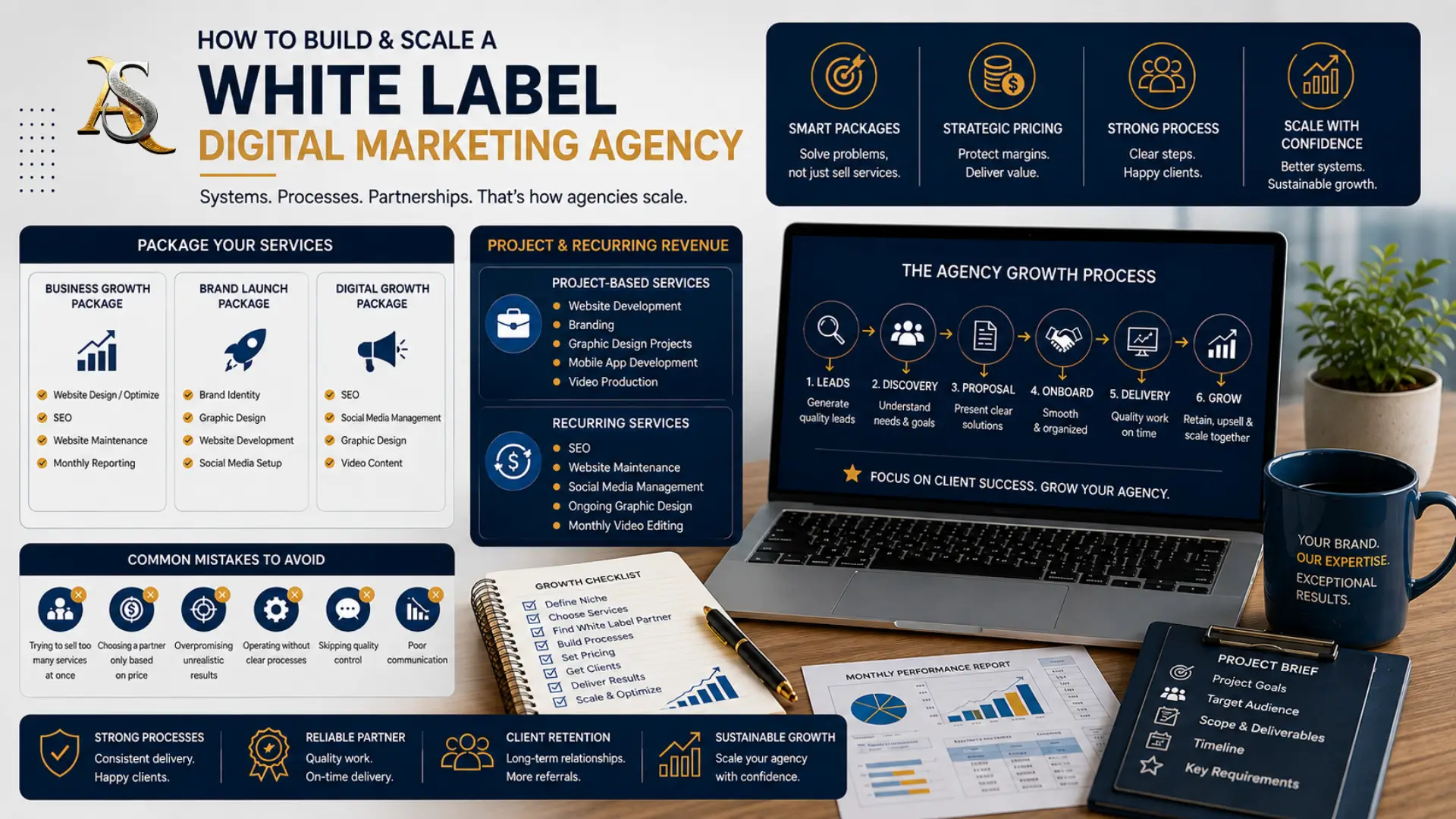
How to Build and Scale a White Label Digital Marketing Agency
Starting a White Label digital marketing agency is only the first step.
Once you have defined your brand, selected your services, found a reliable fulfillment partner, and established a delivery process, the next challenge is building a business that can consistently attract, manage, and retain clients.
This is where many new agencies struggle.
Having access to White Label fulfillment does not automatically create a successful agency.
You still need a clear offer, effective pricing, reliable sales processes, strong client communication, and systems that allow your agency to grow without becoming overwhelmed.
In this section, we’ll look at how to turn a White Label agency into a structured and scalable business.
Package Your Services Instead of Simply Listing Them
One common mistake new agencies make is creating a long list of services without explaining how those services solve specific business problems.
For example:
- SEO
- Website Design
- Graphic Design
- Social Media
- Video Editing
While these are valuable services, a client may not immediately understand what combination of services they actually need.
Instead, consider building service packages around common client goals.
Example: Business Growth Package
A package could include:
- Website Design or Optimization
- SEO
- Website Maintenance
- Monthly Performance Reporting
Example: Brand Launch Package
A package could include:
- Brand Identity
- Graphic Design
- Website Development
- Social Media Setup
Example: Digital Growth Package
A package could include:
- SEO
- Social Media Management
- Graphic Design
- Video Content
The goal is not to force every client into a predefined package.
Instead, packages make your services easier to understand and give clients a clearer starting point.
A White Label model makes this approach particularly flexible because you can combine different areas of expertise without needing every specialist to be part of your internal team.
Create a Pricing Structure That Protects Your Margins
Pricing White Label services requires more than taking the fulfillment cost and adding a random markup.
Your final price should account for the full value and cost of operating your agency.
Consider:
- Fulfillment Costs
- Sales Time
- Discovery and Strategy
- Account Management
- Project Management
- Client Communication
- Quality Assurance
- Revisions
- Software and Tools
- Marketing Costs
- Desired Profit Margin
For example, if your fulfillment partner charges you $1,000 for a project, that does not mean charging your client $1,100 automatically gives you a healthy business margin.
You still need to account for the time and resources your agency invests in managing the project.
A sustainable pricing model gives your agency room to deliver a strong client experience while maintaining profitability.
Choose Between Project-Based and Recurring Revenue
A strong agency often combines different types of revenue.
Project-Based Services
These may include:
- Website Development
- Branding
- Graphic Design Projects
- Mobile App Development
- Video Production
Project-based work can create immediate revenue and provide opportunities to introduce clients to additional services.
For example, a website development client may later need:
- SEO
- Website Maintenance
- Graphic Design
- Social Media Management
Recurring Services
Recurring services can include:
- SEO
- Website Maintenance
- Social Media Management
- Ongoing Graphic Design
- Monthly Video Editing
Recurring revenue can help create more predictable cash flow.
For a growing agency, this predictability can make planning and scaling easier.
A balanced service model can combine larger one-time projects with recurring client relationships.
Build a Simple and Repeatable Sales Process
You do not need an overly complicated sales system when starting your agency.
But you do need a consistent process.
A simple structure may include:
Step 1: Generate Leads
Use a small number of client acquisition channels consistently.
These may include:
- Referrals
- Networking
- SEO
- Content Marketing
- Email Outreach
- Partnerships
- Social Media
- Paid Advertising
The best channel will depend on your audience.
Instead of spreading your efforts across every possible platform, identify the channels most likely to reach your ideal clients.
Step 2: Qualify the Opportunity
Not every lead is the right client.
Before investing significant time into a proposal, understand:
- Their Business Goals
- Current Challenges
- Required Services
- Budget Expectations
- Decision-Making Process
- Project Timeline
This helps you focus your resources on opportunities where your agency can create genuine value.
Step 3: Conduct Discovery
Discovery is where you learn what the client actually needs.
Avoid immediately presenting a solution before understanding the problem.
Ask questions about:
- Their Current Marketing
- Previous Challenges
- Business Objectives
- Target Audience
- Competitors
- Internal Resources
- Growth Goals
The more clearly you understand the situation, the easier it becomes to recommend the right solution.
Step 4: Present a Clear Proposal
A good proposal should explain:
- The Problem or Opportunity
- Recommended Services
- Scope of Work
- Expected Deliverables
- Timeline
- Investment
- Next Steps
Avoid overwhelming the client with unnecessary technical information.
Focus on clarity.
The client should understand exactly what they are receiving and why it matters.
Step 5: Onboard the Client Efficiently
Once the client agrees, the onboarding process should feel organized and professional.
Collect the required:
- Access Credentials
- Brand Assets
- Business Information
- Project Requirements
- Contact Details
- Approvals
A structured onboarding process creates a stronger first impression and reduces delays later.
Managing the Relationship While Your Partner Handles Fulfillment
In a White Label agency, your fulfillment partner may complete the technical work, but your agency remains responsible for the overall client experience.
That means communication should remain organized.
The client should know:
- What is happening
- What happens next
- What information is needed
- When they can expect updates
- Who to contact
You do not need to involve clients in every behind-the-scenes production detail.
Your role is to translate complex work into clear communication.
For example, instead of forwarding technical updates directly from a fulfillment team, your agency can summarize:
“The development phase is progressing as planned. The next step is design review, which we expect to share with you by the agreed timeline.”
This keeps the client experience professional and focused.
Create Strong Internal Briefs
One of the biggest factors in successful White Label fulfillment is the quality of the brief.
The fulfillment team can only work effectively when requirements are clear.
A strong project brief should include:
- Client Background
- Project Goals
- Target Audience
- Required Deliverables
- Brand Guidelines
- Examples or References
- Technical Requirements
- Timeline
- Important Limitations
The clearer the brief, the fewer misunderstandings and revisions you are likely to encounter.
Think of your agency as the bridge between the client and the fulfillment team.
Your ability to translate client requirements into clear instructions is an important part of the value you provide.
Build Quality Control Into Your Process
Never assume that work should automatically go from your fulfillment partner directly to the client.
Your agency should review deliverables before presentation.
Create a quality-control process that checks:
- Scope Requirements
- Accuracy
- Brand Consistency
- Technical Performance
- Grammar and Content
- Visual Quality
- Client-Specific Requirements
This step protects both your agency and the client experience.
Quality control becomes increasingly important as your agency begins managing more projects simultaneously.
Common Mistakes New White Label Agencies Should Avoid
Trying to Sell Too Many Services at Once
Access to multiple White Label services can be an advantage.
However, trying to market every possible service immediately can make your agency’s message confusing.
Start with a focused offer.
You can expand as your systems and client base develop.
Choosing a Partner Only Because They Are Cheap
Low pricing may seem attractive when you are starting.
But poor quality can quickly cost more through:
- Revisions
- Missed Deadlines
- Client Complaints
- Refunds
- Lost Business
Look for a balance between quality, reliability, communication, and pricing.
Overpromising to Clients
Avoid promising unrealistic timelines or results simply to win a project.
Your sales process should align with your actual fulfillment capacity.
Clear expectations are much easier to manage than disappointed clients.
Operating Without Clear Processes
As your agency grows, informal processes become harder to manage.
Document:
- Sales Steps
- Client Onboarding
- Project Briefing
- Quality Control
- Delivery
- Revisions
- Reporting
Simple, repeatable systems can make scaling significantly easier.
How to Scale Without Losing Control
Growth can create new problems.
An agency may go from managing three clients to twenty clients much faster than expected.
Without systems, this can lead to:
- Missed Deadlines
- Poor Communication
- Quality Issues
- Team Confusion
- Client Dissatisfaction
The key is building structure before the workload becomes overwhelming.
Standardize What You Can
Create templates for:
- Client Proposals
- Discovery Questions
- Onboarding Forms
- Project Briefs
- Status Updates
- Quality Checks
- Monthly Reports
Standardization does not mean treating every client the same.
It means creating a reliable foundation so your team is not rebuilding basic processes for every project.
Use Project Management Systems
As the number of projects increases, keeping everything in email or personal notes becomes difficult.
Use a structured system to track:
- Project Status
- Responsibilities
- Deadlines
- Client Feedback
- Revisions
- Deliverables
Your White Label partner should also have a clear method for receiving and managing project information.
The smoother the workflow between your agency and your fulfillment partner, the easier it becomes to scale.
Monitor Capacity Before It Becomes a Problem
Do not wait until your team is overwhelmed before evaluating capacity.
Regularly review:
- Active Projects
- Upcoming Work
- Fulfillment Timelines
- Client Demand
- Revision Volume
- Available Resources
This allows you to identify potential bottlenecks before they affect delivery.
Focus on Client Retention, Not Just New Sales
Winning a new client is valuable.
Keeping a satisfied client can create even greater long-term value.
Strong client retention often comes from:
- Reliable Communication
- Consistent Quality
- Clear Expectations
- Proactive Recommendations
- Transparent Reporting
- Demonstrated Value
Look for opportunities to help clients grow.
For example, a client using your agency for website development may eventually benefit from SEO and ongoing website maintenance.
A social media client may need graphic design or video editing.
When your agency understands the client’s broader goals, you can identify relevant opportunities without turning every conversation into a sales pitch.
Build an Agency That Can Evolve
Your first agency structure does not need to be permanent.
You may begin with a lean team and White Label fulfillment.
As your revenue grows, you might bring certain roles in-house.
You may also continue using White Label specialists for highly technical services or additional capacity.
The goal is to create a flexible structure.
Do not build your agency around assumptions about what it will look like five years from now.
Build around what works today while creating systems that can support future growth.
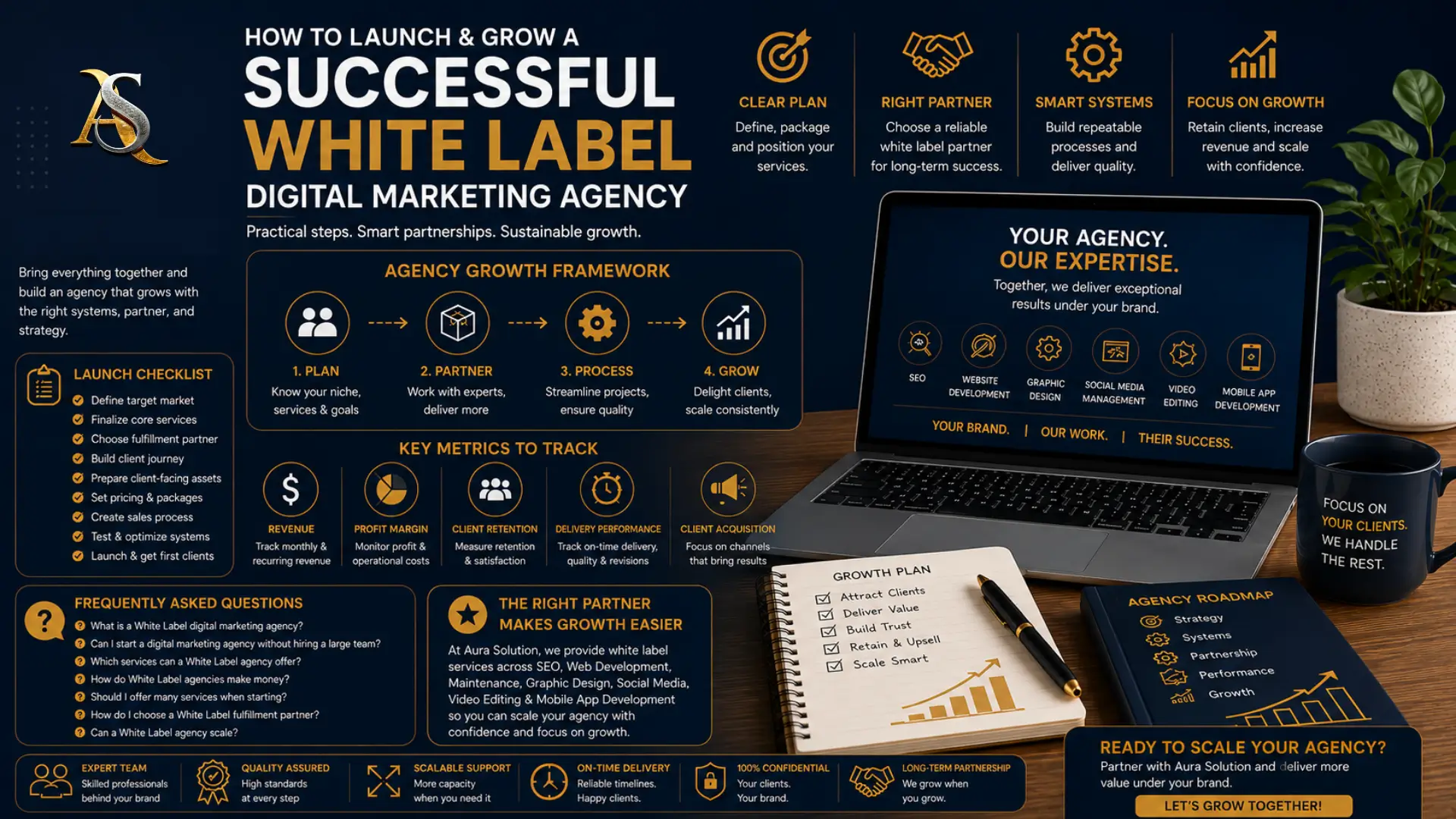
How to Launch and Grow a Successful White Label Digital Marketing Agency
By now, you have a clearer understanding of how the White Label agency model works and how to build the systems needed to operate and scale it.
You have defined your market position, selected your services, created a fulfillment process, developed service packages, considered pricing, and built a structure for managing clients.
The final step is bringing everything together into a practical agency model that can grow over time.
Starting a White Label digital marketing agency does not require building a large team overnight.
However, it does require careful planning.
Your brand, sales process, fulfillment partner, client communication, quality control, and internal systems all work together to shape the success of your agency.
This final section provides a practical framework for launching and growing your White Label agency with greater confidence.
A Practical White Label Agency Launch Checklist
Before actively promoting your agency, it can be helpful to review the foundations of your business.
1. Define Your Target Market
Be clear about who you want to serve.
Your target market might include:
- Small Businesses
- Local Businesses
- E-commerce Companies
- Professional Service Providers
- Startups
- Established Companies
- Other Marketing Agencies
You do not need to serve everyone.
A clear understanding of your ideal client can help shape your messaging, service packages, pricing, and marketing strategy.
2. Finalize Your Core Services
Start with a manageable selection of services that align with client needs.
Depending on your agency model, these may include:
- SEO
- Website Design and Development
- Website Maintenance
- Graphic Design
- Social Media Management
- Video Editing
- Mobile App Development
As your agency grows, you can expand your offering based on actual client demand.
3. Choose a Reliable Fulfillment Partner
Your White Label partner should be evaluated carefully.
Consider:
- Experience
- Portfolio Quality
- Communication
- Available Services
- Turnaround Times
- Quality Control
- Revision Processes
- Scalability
- Confidentiality
- Long-Term Reliability
Remember that your clients will associate the quality of the final work with your agency.
Your fulfillment partner may work behind the scenes, but their performance directly affects your reputation.
4. Establish Your Client Journey
Map out what happens from the moment a potential client contacts your agency.
A simple journey might include:
Lead → Discovery → Proposal → Agreement → Onboarding → Project Brief → Fulfillment → Quality Review → Delivery → Ongoing Support
Documenting this process makes it easier to create a consistent experience.
As your agency grows, having an established workflow can prevent confusion and reduce the risk of important steps being missed.
5. Prepare Your Client-Facing Assets
Before launching, make sure you have the essential materials needed to communicate professionally.
This may include:
- Agency Website
- Service Pages
- Portfolio or Case Studies
- Proposal Templates
- Discovery Forms
- Client Onboarding Documents
- Project Brief Templates
- Reporting Templates
- Client Communication Templates
You do not need to create every possible document before getting your first client.
Start with the materials that support your immediate sales and delivery process.
How to Choose the Right White Label Partner
Choosing the right partner can be one of the most important decisions your agency makes.
A strong partnership should support your growth rather than create additional management problems.
Look Beyond the Price
Pricing matters.
However, the cheapest option is not always the most profitable option.
A lower-cost provider may create hidden costs through:
- Excessive Revisions
- Missed Deadlines
- Poor Communication
- Quality Problems
- Client Complaints
- Lost Business
Instead of evaluating a provider based only on the price of individual services, consider the overall value of the partnership.
Evaluate Communication
Communication becomes especially important when you are managing multiple client projects.
Ask questions such as:
- How are projects submitted?
- Who is the primary point of contact?
- How often are updates provided?
- How are urgent requests handled?
- How are revisions managed?
- What happens if a deadline changes?
A strong communication process can save significant time as your agency grows.
Review Their Range of Services
Working with a partner that can support multiple services may simplify your agency’s operations.
For example, instead of managing separate providers for SEO, website development, graphic design, social media, and video editing, you may benefit from a partner with broader capabilities.
This can make it easier to coordinate projects and maintain consistent quality.
At the same time, quality should always be more important than simply having the longest list of services.
Start With a Test Project
Before moving all of your client work to a new partner, consider starting with a smaller project.
This allows you to evaluate:
- Communication
- Project Management
- Quality
- Attention to Detail
- Turnaround Time
- Revision Handling
A test project can provide valuable insight into what working together will actually be like.
Key Metrics to Monitor as Your Agency Grows
Growth should not be measured only by the number of new clients.
A successful agency needs to understand whether its operations are becoming healthier and more sustainable.
Consider monitoring the following areas.
Revenue
Track both:
- Monthly Revenue
- Recurring Revenue
This can help you understand how much of your business depends on one-time projects versus ongoing client relationships.
Profit Margin
Revenue alone does not tell you how profitable the agency is.
Monitor the costs associated with:
- Fulfillment
- Software
- Sales
- Marketing
- Project Management
- Contractors
- Internal Team Members
Understanding your margins can help you make better pricing and growth decisions.
Client Retention
A growing client list is valuable, but retaining clients is equally important.
Track:
- How long clients stay
- Which services have the strongest retention
- Why clients leave
- Opportunities to provide additional value
Long-term relationships can create more predictable revenue and reduce the pressure to constantly replace lost clients.
Project Delivery Performance
Monitor whether projects are being delivered according to expectations.
Consider:
- On-Time Delivery
- Revision Volume
- Client Feedback
- Quality Issues
- Project Delays
These metrics can help you identify operational problems before they become larger issues.
Client Acquisition
Understand where your best clients come from.
Track sources such as:
- Referrals
- Organic Search
- Social Media
- Partnerships
- Email Outreach
- Paid Advertising
Over time, this can help you focus more resources on the channels that generate the strongest opportunities.
Common Challenges and How to Handle Them
Every growing agency will face challenges.
The goal is not to eliminate every problem but to build systems that make problems easier to manage.
Challenge: Too Much Client Communication
As the number of clients increases, constant communication can consume a large amount of time.
Solution: Create structured communication processes, including scheduled updates, clear points of contact, and standardized reporting.
This helps clients stay informed without requiring your team to manually explain every stage of every project.
Challenge: Increasing Revision Requests
Repeated revisions can affect both profitability and delivery timelines.
Solution: Improve your discovery and briefing process.
Make sure expectations, scope, deliverables, and approval requirements are clearly defined before production begins.
Challenge: Projects Becoming Disorganized
As more projects are added, it becomes easier for deadlines and details to be missed.
Solution: Use a structured project management process with clear responsibilities, deadlines, project stages, and quality checks.
Challenge: Growing Faster Than Your Systems
Rapid growth can create pressure on both your agency and your fulfillment partner.
Solution: Monitor capacity regularly.
Do not wait until projects are delayed before identifying potential bottlenecks.
Growth should be supported by processes, not just enthusiasm.
Challenge: Losing Control Over Quality
As project volume increases, it can become tempting to reduce the amount of internal review.
Solution: Keep quality control as a required stage of every project.
Your agency should remain accountable for the final deliverable presented to the client.
When Should You Bring Services In-House?
One advantage of the White Label model is flexibility.
You do not need to make every service decision permanently.
As your agency grows, you may decide to bring certain functions in-house.
This could make sense when:
- Demand for a service becomes consistently high
- Internal control becomes strategically important
- The cost of outsourcing becomes less efficient
- You need faster collaboration
- You want to develop a specialized internal capability
However, bringing services in-house should be a strategic decision rather than an automatic response to growth.
Many successful agencies continue using external specialists and White Label partners even after building internal teams.
The goal is to create the structure that works best for your agency.
Build Around Demand, Not Assumptions
One of the biggest advantages of starting with a White Label model is the ability to remain flexible.
Instead of building a large organization based on what you think clients might need, you can observe actual demand.
For example, you may initially offer a broad range of services and discover that your strongest opportunities are in:
- Website Development
- SEO
- Website Maintenance
That information can help you decide where to invest additional resources.
Your agency should evolve based on:
- Client Demand
- Profitability
- Market Opportunities
- Operational Capacity
- Your Long-Term Business Goals
There is no requirement for every agency to follow the same growth path.
Why the Right Partnership Can Make Growth Easier
A White Label partnership is most effective when both sides understand their roles.
Your agency focuses on the client-facing side of the business, which may include:
- Brand Development
- Marketing
- Sales
- Client Relationships
- Strategy
- Project Management
- Quality Assurance
Your fulfillment partner provides the expertise and production capacity required to deliver the agreed services.
When these responsibilities are supported by clear communication and reliable processes, the partnership can create a scalable operating model.
At Aura Solution, we understand that agencies need more than an outsourced service provider.
They need a dependable team that can support delivery while allowing them to maintain ownership of their client relationships and brand.
Our White Label services are designed to support agencies with a range of digital capabilities, including:
- Website Development
- Website Maintenance
- SEO
- Graphic Design
- Social Media Management
- Video Editing
- Mobile App Development
The goal is to provide agencies with access to professional fulfillment support while giving them the flexibility to focus on growth.
FAQs
What is a White Label digital marketing agency?
A White Label digital marketing agency sells services under its own brand while another team or provider completes some or all of the fulfillment work behind the scenes.
The agency remains responsible for the client relationship, communication, and overall client experience.
Can I start a digital marketing agency without hiring a large team?
Yes. A White Label fulfillment model can allow you to access specialized capabilities without immediately building an extensive in-house team.
You can focus on sales, client relationships, strategy, and business development while your fulfillment partner supports service delivery.
Which services can a White Label agency offer?
Depending on the capabilities of your fulfillment partner, services may include SEO, website development, website maintenance, graphic design, social media management, video editing, mobile app development, and other digital services.
How do White Label agencies make money?
A White Label agency typically charges clients based on the value and scope of the service while managing the costs associated with fulfillment, account management, project management, sales, software, and other operational expenses.
The difference between revenue and the total cost of delivery contributes to the agency’s profit margin.
Should I offer many services when starting?
Not necessarily.
It is often better to start with a focused service offering that aligns with your target market.
You can expand your services as you develop stronger processes and identify client demand.
How do I choose a White Label fulfillment partner?
Look at more than pricing.
Evaluate quality, experience, communication, turnaround times, available services, scalability, confidentiality, revision processes, and overall reliability.
A test project can also help you understand how the partnership works in practice.
Can a White Label agency scale?
Yes. One of the main advantages of the model is the ability to increase fulfillment capacity without needing to immediately hire a large number of internal specialists.
However, successful scaling still requires strong processes, quality control, client management, and capacity planning.
Final Thoughts
Starting a White Label digital marketing agency can provide a practical path for entrepreneurs and agencies that want to offer professional services without building every capability internally from day one.
But the White Label model itself is not a shortcut to success.
The strongest agencies still need:
- A Clear Market Position
- Services That Solve Real Client Problems
- Reliable Fulfillment
- Sustainable Pricing
- Strong Client Communication
- Quality Control
- Repeatable Processes
- A Consistent Sales Strategy
The advantage is flexibility.
You can focus on building your brand and generating demand while working with experienced specialists to support service delivery.
Start with a clear foundation.
Validate your business model.
Build strong client relationships.
Document your processes.
Monitor your performance.
Then scale around what is actually working.
With the right strategy and the right fulfillment support, a White Label agency can develop from a lean operation into a structured and scalable business without requiring you to build every department before you are ready.
Explore More
Blogs

Why Every Business Needs a Mobile-Friendly Website in 2025
As smartphone usage continues to dominate web traffic, businesses that neglect their mobile presence r
Aura Solution
June 15. 2025

How to Choose the Right Digital Marketing Partner in the USA
Choosing a digital marketing agency is a major decision for any business. With so many options, how do you find ....
Aura Solution
31 May 2025

Top Digital Marketing Strategies That Drive Results for US Businesses in 2025
As we move through 2025, digital marketing continues to evolve at a rapid pace. With increased competition
Aura Solution
15 May 2025